Inside the World's First Vision-Only Autonomous Drone Racing Championship
At A2RL 2026 in Abu Dhabi, 14 teams raced drones using nothing but a single camera and a motion sensor — no LiDAR, no external computing. Here's what happened.
By Riley Cross · January 28, 2026 · 8 min read · fpv-racing
In January 2026, fourteen teams gathered in Abu Dhabi for a race unlike anything in motorsport history: drones with no human pilot, no LiDAR, no stereo vision, and no external computing — just a single forward-facing camera, a motion sensor, and an onboard AI making every decision in real time.
The event, the second-ever A2RL Drone Championship, was designed as a deliberate stress test. Organisers stripped away every sensor shortcut that typically helps autonomous vehicles navigate, forcing competing teams to solve high-speed perception and control using only what a human pilot effectively has: eyes and instinct, translated into code.
The Results
The numbers were striking. The Technology Innovation Institute's TII Racing team posted the fastest autonomous lap of the championship at 12.032 seconds, narrowly ahead of MAVLAB's 12.832-second lap in a separate Multi-Drone Gold Race category — an event specifically testing whether multiple AI-piloted drones could navigate a shared course without colliding, a genuinely difficult multi-agent coordination problem.
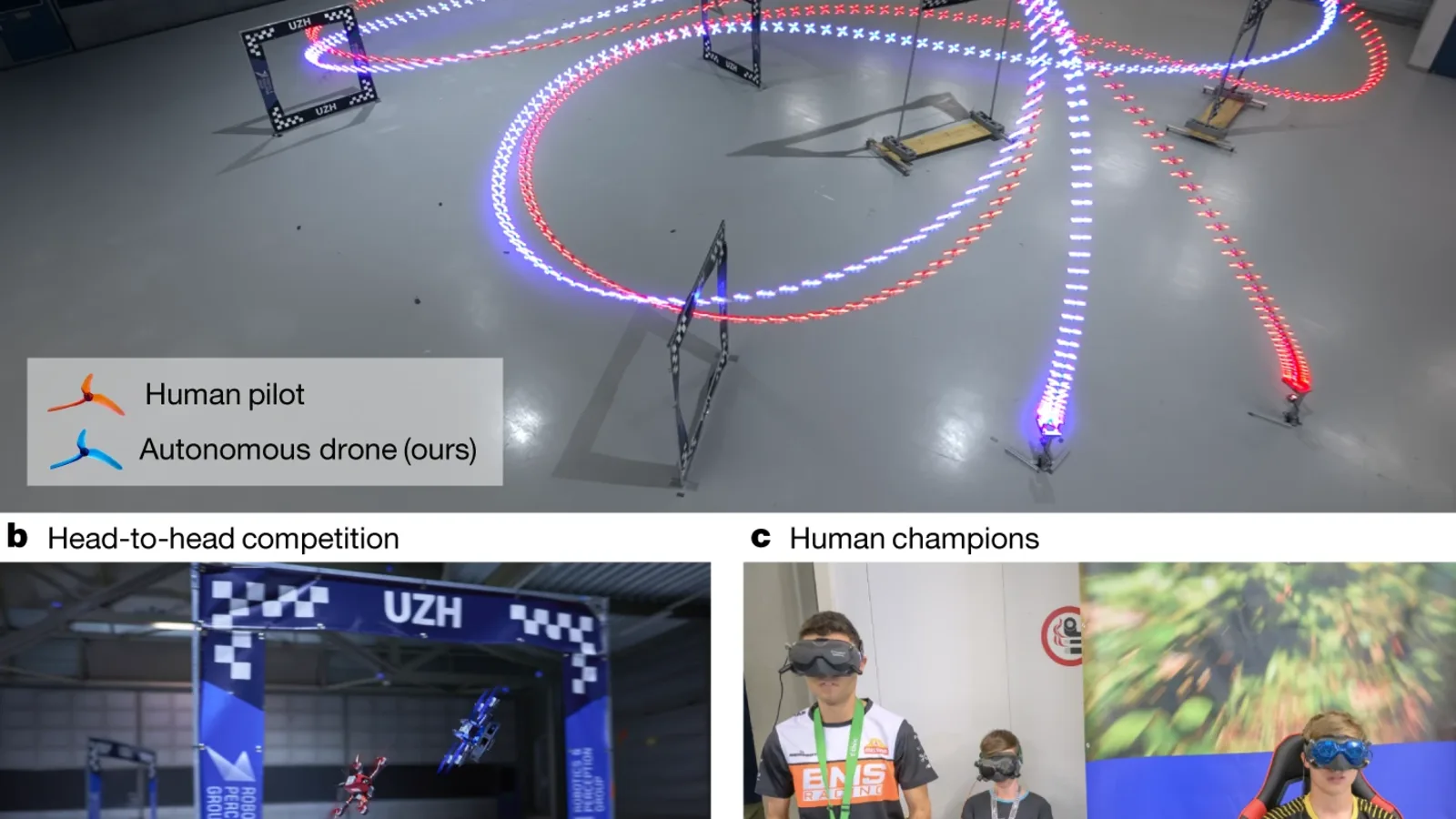
The marquee event was Human vs AI: a head-to-head format pitting autonomous drones directly against elite first-person-view pilots. The previous year's edition had already delivered a watershed moment when an AI-piloted drone outpaced top human pilots for the first time. The 2026 edition raised the stakes further, fielding six AI teams against six leading FPV pilots from ten countries.
Why the Track Matters
The course itself tells you everything about the difficulty involved — a tight 27-by-35-metre indoor space, a far cry from a sweeping circuit. At those dimensions, split-second perception errors are unforgivable. A drone moving at racing speed through a gap that leaves millimetres of clearance on each side has to solve perception, planning, and execution faster than any human reaction time allows. The fact that AI systems are doing this on a single camera feed makes the achievement significantly more remarkable than it sounds on paper.
Beyond the Race
Organisers are explicit that the racing is a proving ground, not the end goal. The autonomy stacks being refined at A2RL — real-time perception, low-latency control loops, multi-agent coordination — feed directly into real-world drone deployment challenges, from logistics to search and rescue. Every lap completed is also a dataset generated.
A parallel effort is scaling the concept further. Anduril, the defense technology company founded by Palmer Luckey, launched its own AI Grand Prix in 2026 in partnership with the Drone Champions League. The format strips things down even further: competing teams race identical drones built by Neros Technologies, with zero hardware modifications allowed. The only variable is software. Qualification began in spring 2026 using virtual simulation environments, with the live final to follow.
Drone racing has always had an inherent advantage as a "robot sport" — it was built from the ground up around remote and autonomous control, rather than retrofitting human-style competition onto a machine. As AI pilots close the gap on elite humans, it may end up being the sport where machine-versus-human competition matures fastest.
FAQs
What makes A2RL's format different from typical autonomous drone tests? A2RL deliberately restricts competing drones to a single camera and basic motion sensor, banning LiDAR, stereo vision, and external computing — forcing teams to solve high-speed navigation with minimal sensor input, closer to how a human pilot operates.
Have AI drones actually beaten human pilots in competition? Yes — A2RL's Human vs AI format saw an autonomous drone outpace elite human FPV pilots for the first time in its earlier edition, a result organisers describe as a milestone moment for the sport.
What is the Anduril AI Grand Prix? A global autonomous drone racing competition launched in 2026, open to university teams and independent engineers, using identical hardware from Neros Technologies so that competitive advantage comes entirely from software.
Is autonomous drone racing relevant outside of sport? Yes — the perception, control, and multi-agent coordination systems developed for these races are directly applicable to real-world autonomous drone deployment in logistics, inspection, and emergency response.