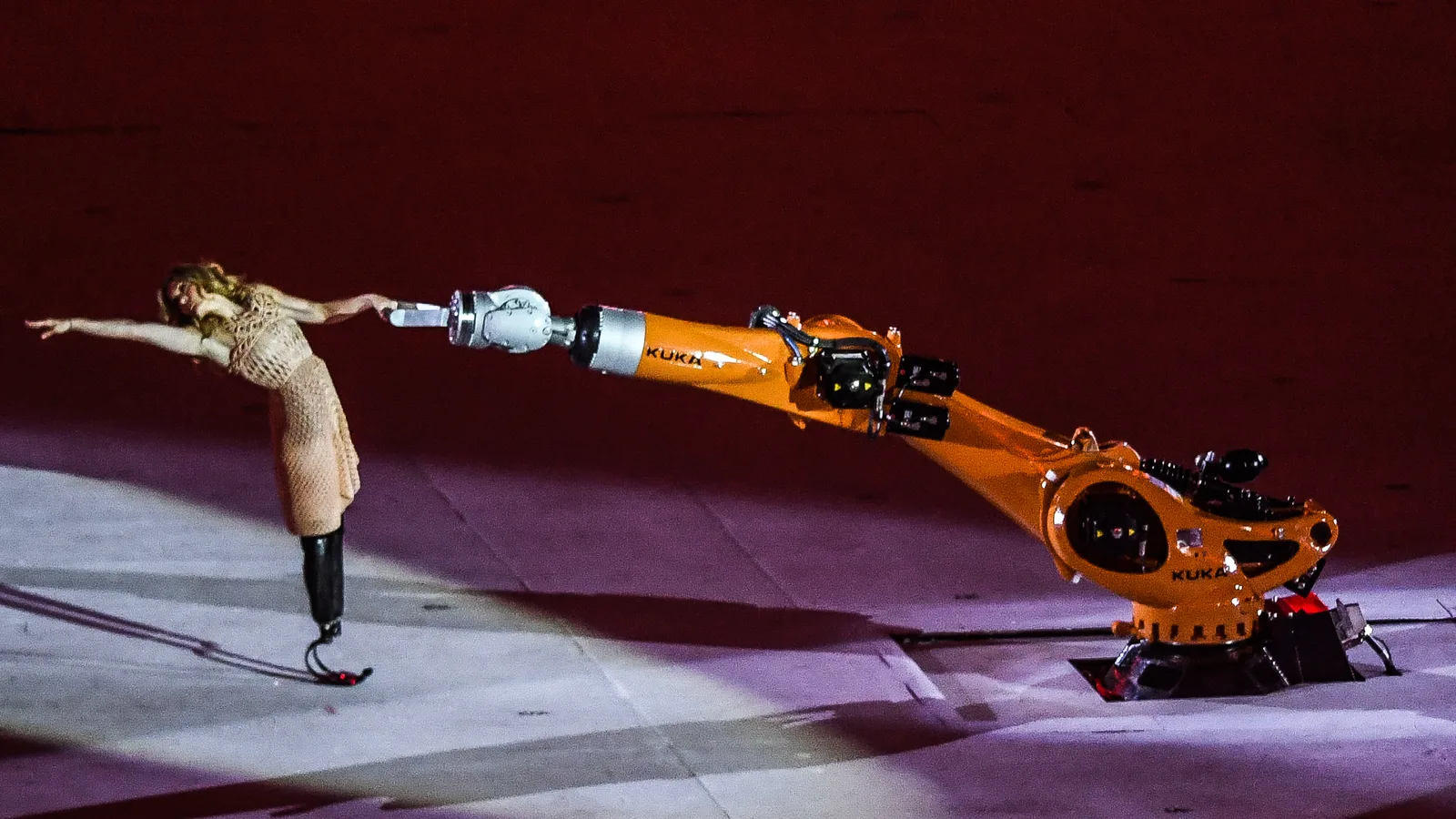
Faster, Stronger, Smarter: How AI Is Quietly Revolutionising Elite Sport
From AI-powered injury prediction and automated officiating to talent scouting algorithms, artificial intelligence is reshaping how sport is played, coached, and watched — at a pace accelerating year by year.
By RSW Editorial · September 15, 2025 · 9 min read · robot-athletes
You won't see it on the scoreboard or hear it mentioned in post-match interviews. But in stadiums, training grounds, and front offices across the world, artificial intelligence is reshaping how sport is played, coached, scouted, and watched — at a pace that's accelerating year by year.
As of mid-2025, 75% of professional sports teams across major leagues were using real-time analytics to inform performance decisions. The AI in sports market, worth $1.03 billion in 2024, is projected to more than double to $2.61 billion by 2030. This isn't a future story. It's happening now.
Injury Prevention
Some of the most transformative applications are invisible to fans. Uplift Labs, named one of Fast Company's World's Most Innovative Companies in 2026, has built an AI-powered motion capture system that replaces $50,000 specialist lab equipment with nothing more than an iPhone. Its movement assessment algorithms identify high-risk biomechanical patterns before an injury occurs, while an AI coach translates complex data into plain coaching language.
By the end of 2025, Uplift's platform was deployed across more than 300 professional teams globally, from NFL franchises to Premier League football clubs. Teams are reporting measurable reductions in soft-tissue injury rates — the kind of data that translates directly into competitive results, not just medical records.
Officiating
FIFA's Semi-Automated Offside Technology (SAOT) — first deployed at the 2022 World Cup — uses 12 dedicated cameras per stadium to track 29 data points on every player 50 times per second, while a sensor inside the ball transmits positional data 500 times per second. The average offside review time has fallen from 70 seconds to around 23 seconds.
The 2026 FIFA World Cup will go further still: in January 2026, FIFA president Gianni Infantino announced that every player at the tournament would be tracked by FIFA Connected Ball Technology and a new generation of AI-assisted officiating tools, extending automated precision across all set-piece and foul decisions, not just offside calls.
Talent Scouting
AI is also finding talent the old system misses. Tools like AiSCOUT use computer vision and movement analysis to identify gifted young footballers who might never catch a scout's eye in person. As the platform's director of sport science put it: there are too many great young players slipping through the system — AI is starting to catch them.
The implications reach beyond football. In tennis, human line judges are already a thing of the past: the ATP Tour confirmed that by 2025, all out-of-bounds calls across its events would be handled by automated systems. In Formula 1, strategy departments rely on machine learning models to simulate thousands of race scenarios in real time, shaping pit-stop decisions that can win or lose championships.
Where It's Going
The convergence of real-time data, computer vision, and large-scale AI modelling is producing tools that augment human coaches and officials rather than replacing them — at least for now. But the direction of travel is clear.
As AI systems grow more capable and the cost of deploying them falls, the advantages available to better-resourced organisations will compound. The sport that figures out how to use these tools most effectively — and most ethically — will have a structural edge that goes well beyond any individual player.
The line between human and machine performance is blurring. Sport will never look quite the same again.