Autonomous Obstacle Navigation: What Humanoid Wall Crashes Can—and Cannot—Tell Us
Viral training crashes expose the importance of stopping distance and safety planning, but video alone cannot diagnose a robot's sensors or software.
By Riley Cross · October 2, 2026 · 3 min read · robot-athletes
#humanoid#speed#ai#arena-build
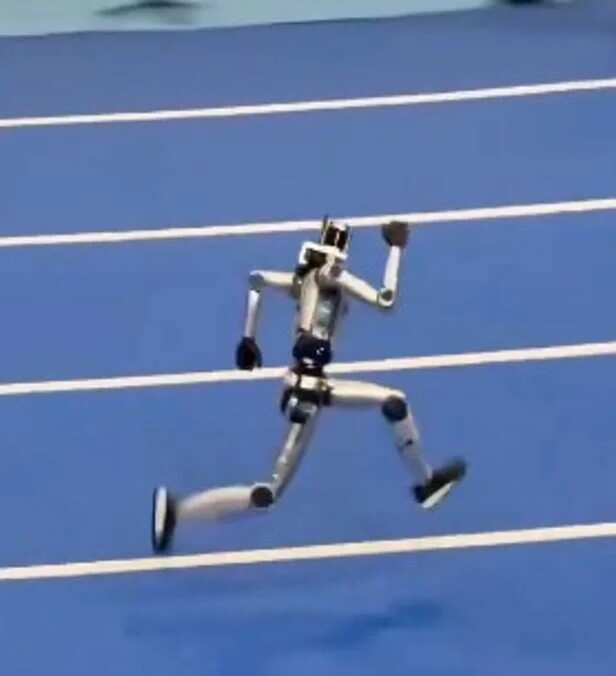
Footage of humanoid robots colliding with barriers during preparations for the 2026 World Humanoid Robot Games spread widely online. The clips showed a real engineering concern: reaching a high speed and stopping safely are different capabilities.
They did not show a complete diagnostic record. Without logs, controller settings and an account from the team, it is not possible to establish whether a collision came from perception, a command error, trajectory planning, loss of traction or another fault.
That distinction matters. Our robot sprint-physics analysis explains why maximum speed is only one part of a useful performance benchmark. Braking and run-off planning belong beside it.
Delay becomes distance
A moving robot travels while its sensors gather information, its software processes it and its actuators respond. At 10 m/s, a 100-millisecond delay represents one metre of forward motion before any effective deceleration begins.
This is an illustrative calculation, not a measured latency from the viral footage. The principle is straightforward: safety margins must account for the entire response chain, not only the nominal frame rate of a camera.
Different delays may occur at different stages. A fresh sensor reading can be held in a queue, a planner can operate on an old state estimate, or a requested joint action can take time to affect the robot's movement.
A biped cannot brake like a wheeled cart
For constant deceleration, the idealised stopping-distance relationship is d = v² / (2a). Doubling speed multiplies the braking distance by four when available deceleration stays the same.
A humanoid's actual deceleration is more complicated. It must place its feet, preserve balance and keep contact forces within the available friction. Abruptly commanding a slower speed can cause a fall rather than a controlled stop.
The test environment therefore needs more than a finish line. It needs a run-off zone matched to the tested speed, controlled access and an emergency procedure that accounts for both a running robot and a falling one.
Perception can degrade under motion
Camera motion, changing illumination and occlusion can affect obstacle detection. Range measurements also need to be interpreted in relation to the robot's moving body. Inertial information and timestamp accuracy help the system distinguish a real obstacle from a poorly aligned observation.
These are potential failure mechanisms. They should not be labelled the cause of a specific incident just because they sound technically plausible.
An actual investigation would align sensor data, state estimates, commands and measured movement on a shared timeline. It would also establish whether autonomous obstacle avoidance was enabled during that particular run.
What teams should document
- The intended path, target speed and stopping command.
- Sensor timestamps, processing delays and state-estimate confidence.
- Foot slip, contact timing and actuator-limit events.
- Battery and controller faults, including emergency-stop behaviour.
- The separation between spectators, equipment and the full run-off area.
Each item helps distinguish a software issue from a physical limitation or an unsuitable test setup.
A better lesson than the viral caption
The important lesson is not that fast robots are inherently out of control. It is that a performance demonstration needs an equally explicit safety envelope. Speed, stopping, reliability and supervision should be reported together.
Future event coverage would benefit from team-provided incident reports rather than confident diagnoses assembled from a few seconds of footage.
Reporting basis
Mashable's report on the pre-event training clips establishes the context. The calculations and possible failure modes here are general engineering explanations, not a forensic finding about any named robot.
Cover photograph: training-incident coverage via Times of India / PublishStory.