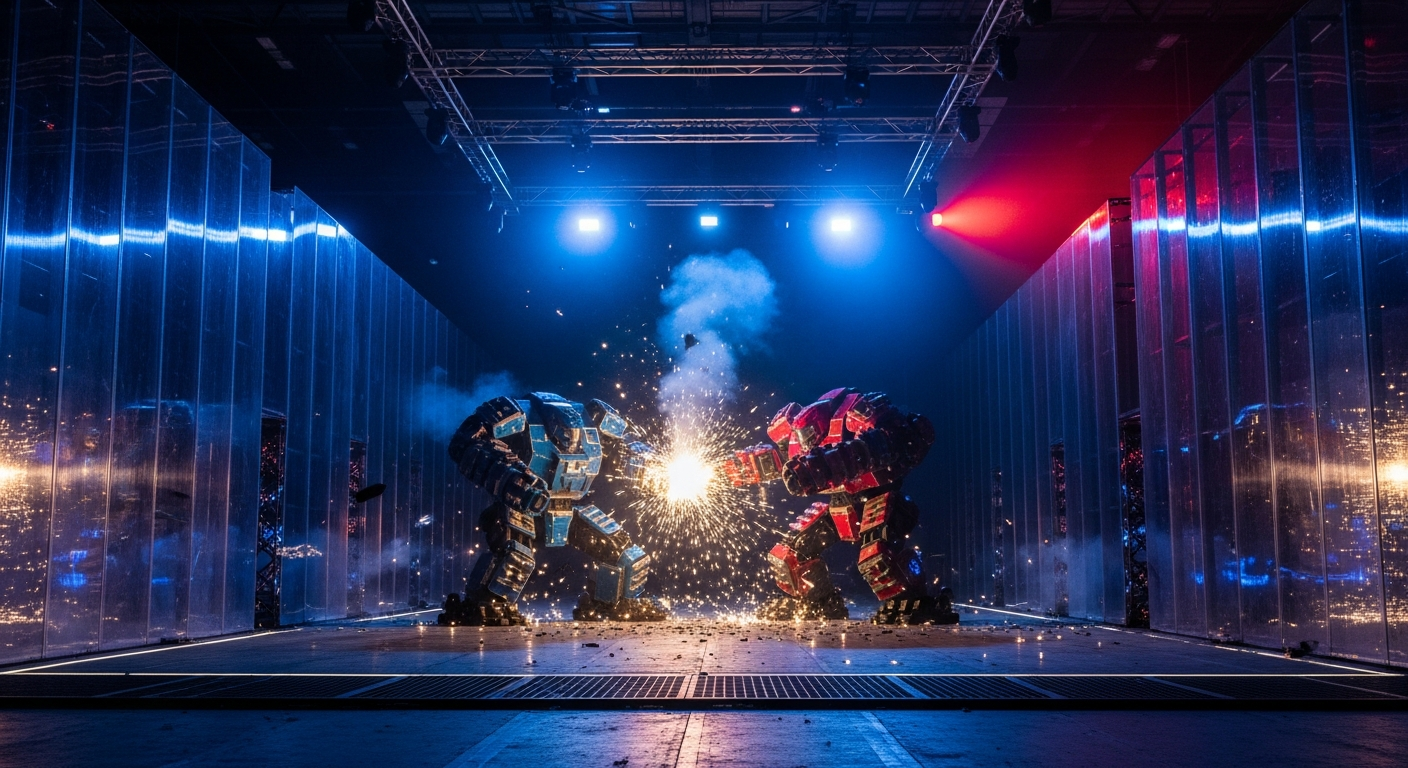
BattleBots 2025 Power Rankings: The Heavyweights That Define the Season
A deep look at the BattleBots robots winning right now — the weapons, builders, and design choices that separate the elite from the rest of the 250-pound bracket.
By Riley Cross · November 12, 2025 · 9 min read · combat-robotics
The 2025 BattleBots season has reinforced something that anyone who has watched the show closely already suspects: combat robotics at the heavyweight level is no longer a hobbyist sport. The robots competing for the Giant Nut are full engineering programs, often with multi-year development cycles, six-figure budgets, and machinist-level fabrication behind every wedge and weapon.
This guide walks through the bots driving the conversation in 2025, the design patterns separating winners from also-rans, and the parts and tools the top builders rely on between fights. Whether you are a builder eyeing your first heavyweight, a fan trying to understand the meta, or a viewer wanting to know which match-ups actually matter, this is the rankings breakdown to start with.
How the 2025 Meta Has Shifted
If you compared a 2018 heavyweight bracket to a 2025 one, three differences would jump out. First, vertical spinners have continued to dominate as the safest high-power weapon configuration. Second, full-body horizontal spinners have evolved into more controllable designs after years of "spin-launch" matches that ended with both robots in the wall. Third, control bots — wedges, lifters, and grabbers without a high-energy weapon — have re-emerged as legitimate threats once builders learned how to neutralize spinners with active geometry and well-placed armor.
We covered the foundational physics behind these weapon classes in our breakdown of the most dangerous BattleBots machines, and the 2025 season is essentially the continuation of those same trends — with the difference that the engineering tolerances are tighter and the weapon energies are higher than ever.
The other shift worth noting is materials. Top teams have moved almost entirely to AR400, AR500, and HARDOX-grade abrasion-resistant steel for primary armor, with titanium reserved for weapon-facing wedges and ablative panels. The cost of that shift is real, but the survival rate over a five-fight bracket has measurably improved for the teams that made the investment.
The Top Tier: Robots Built to Win Brackets
These are the heavyweight programs that have shown up to recent seasons with the engineering depth, the driver experience, and the spare-parts pipeline to actually run a full bracket.
Riptide
Aren Hill's Riptide reset the bar for vertical spinner weapon energy when it joined the field, and it remains one of the cleanest high-power designs in the 2025 grid. The full-width vertical spinner stores enormous energy in a hardened steel bar, and the robot's low profile and well-tuned drivetrain mean it gets there first in most exchanges. Riptide's losses have generally come from drivetrain damage taken in trade hits, not from being out-weaponed.
Hydra
Jake Ewert's Hydra is still the canonical hydraulic flipper in heavyweight competition, and it is still terrifying to draw in a bracket. The robot's launch energy is high enough to send 250-pound opponents over the arena fence — when the geometry of a fight allows Hydra to scoop, the match is usually over inside thirty seconds. Hydra's weakness has always been weapon-versus-weapon trades against heavy spinners, but its bracket performance against control bots and lighter spinners is among the best in the sport.
Hypershock
Will Bales has been competing at the top of BattleBots since the show's 2015 reboot, and Hypershock remains the rare program that has stayed competitive across multiple weapon configurations. The current Hypershock builds around a high-energy vertical spinner with the kind of driving polish that only comes from a decade of competition reps. We featured Hypershock in our earlier BattleBots top robots breakdown for a reason — the program keeps reinventing itself.
Sawblaze
Jamison Go's Sawblaze is the textbook example of a hammersaw build done right: a strong driving wedge, a powered weapon arm, and a saw blade that can either cut into stranded opponents or be used as a controlling appendage. Sawblaze has historically been one of the bracket-survival leaders, partly because the design avoids the high-energy trade hits that destroy spinners. We profiled Sawblaze at the top of our current rankings — its consistency is the case for the design philosophy.
Tantrum
Aptyx Designs' Tantrum has remained one of the most well-rounded heavyweights in the sport. The current build pairs a vertical spinner drum with a clever modular front geometry that lets the team adjust between fights based on the opponent. Tantrum is the bot most likely to win a judges' decision in this bracket — its driving discipline and damage management are both at the top of the field.
End Game
Jack Barker's End Game won BattleBots World Championship V and remains a benchmark for weapon power and fabrication quality. New Zealand's combat robotics community has produced an outsize share of the world's elite heavyweights, and End Game — along with several follow-on builds from the same engineering circle — keeps demonstrating why.
The Challenger Tier: Bracket-Disrupting Bots
These programs may not be favored to win a championship in a given year, but they regularly knock out top seeds and define the brackets they enter.
- Witch Doctor — Mike and Andrea Gellatly's drum-spinner program is one of the most consistently competitive builds in the sport, and it has won more than its share of upsets against higher-seeded bots.
- Minotaur — Daniel Freitas' undercutter has always punched above its construction weight, and the Brazilian team's repair pace between rounds is famously fast.
- Cobalt — David Eaton's vertical spinner is one of the highest-energy weapons in the sport, and a clean hit from Cobalt ends most matches immediately.
- Yeti — Greg Gibson's vertical spinner is a long-running fan favorite that periodically reaches the upper bracket and forces top seeds into trade hits.
- Ribbot — David Jin's amphibian-themed bot has continually upgraded into a legitimate spinner-class threat with strong driving.
What the Top Builders Have in Common
After watching enough bracket runs, certain patterns repeat across the winning teams.
They build for repairability between rounds. A bracket has no time for a from-scratch rebuild. The bots that win brackets are the ones whose drivetrain modules, weapon assemblies, and armor panels can be swapped out in the pit window. We laid out the philosophy behind that in our pit crew essentials guide, and it is on display in every televised pit shot.
They invest in driver reps. Combat robotics rewards driver experience the way motorsport does. The best heavyweight teams put their drivers in front of practice rigs and small-scale combat events between TV appearances. Driving discipline shows up under pressure — the robot that wins a 30-second exchange usually does so because the driver controlled the geometry, not because the weapon was bigger.
They engineer for the arena, not just the opponent. The interior of a heavyweight arena is a hostile environment in its own right. The hazards, the floor, the wall geometry, and the camera shielding all influence which weapon configurations actually pay off. We took a deep look at this in Inside the BattleBox Arena, and the design choices in that environment continue to favor compact, low-profile bots that exploit hazards.
They source the right materials. The shift to AR400/AR500 and HARDOX armor is now standard at the top of the bracket. Builders looking to upgrade their own weight class can source combat-grade armor stock and brushless drive kits as a starting point — match those upgrades with proper machining and hardware-grade fasteners and you have the foundation of a competitive build.
Frequently Asked Questions
Who is the most dominant BattleBots robot in 2025?
There is no single dominant robot in the current bracket — the top tier is genuinely competitive, and any of Riptide, Hydra, Tantrum, Hypershock, Sawblaze, Cobalt, or End Game can win a given matchup. The bot most likely to win a five-fight bracket is the one whose engineering survives bracket attrition, which is usually a vertical spinner or a hammersaw with strong driving.
What weapon type wins the most BattleBots matches?
Vertical spinners have produced the largest number of decisive wins over the past several seasons because they manage the energy of a hit better than horizontal spinners (less sideways debris, less self-launch). Hammersaws and well-driven control bots account for most of the rest. Pure horizontal full-body spinners have declined as a percentage of the meta because their downside cases are catastrophic.
Can you build a BattleBots-class robot at home?
The 250-pound heavyweight class is realistically out of reach for a solo hobbyist working out of a garage — the materials, machining, and weapon energy are at engineering-firm levels. The 3-pound Beetleweight and 12-pound Hobbyweight classes, however, are very accessible, and most televised heavyweight builders started exactly there. Local insurance-rated combat events run those weight classes regularly through organizations like SPARC.
What to Watch in the Next Brackets
Three things will define the next season cycle. First, weapon energy is going to keep climbing — we are now well past the point where a clean weapon-to-weapon trade between two heavyweights is survivable for either bot, and teams will keep refining armor packages to absorb hits without losing a wheel. Second, control bots will continue to evolve geometry that spoils vertical spinners on contact, which is the biggest counter-meta development of the past two seasons. Third, more international teams — particularly from New Zealand, Brazil, and the UK — will keep showing up with builds that match or exceed the engineering quality of the long-running American programs.
For published athletic benchmarks with reporting conditions, check our sourced performance records. For the combat format, read our BattleBots Pro League group-stage strategy guide and our telemetry and pit-diagnostics explainer.