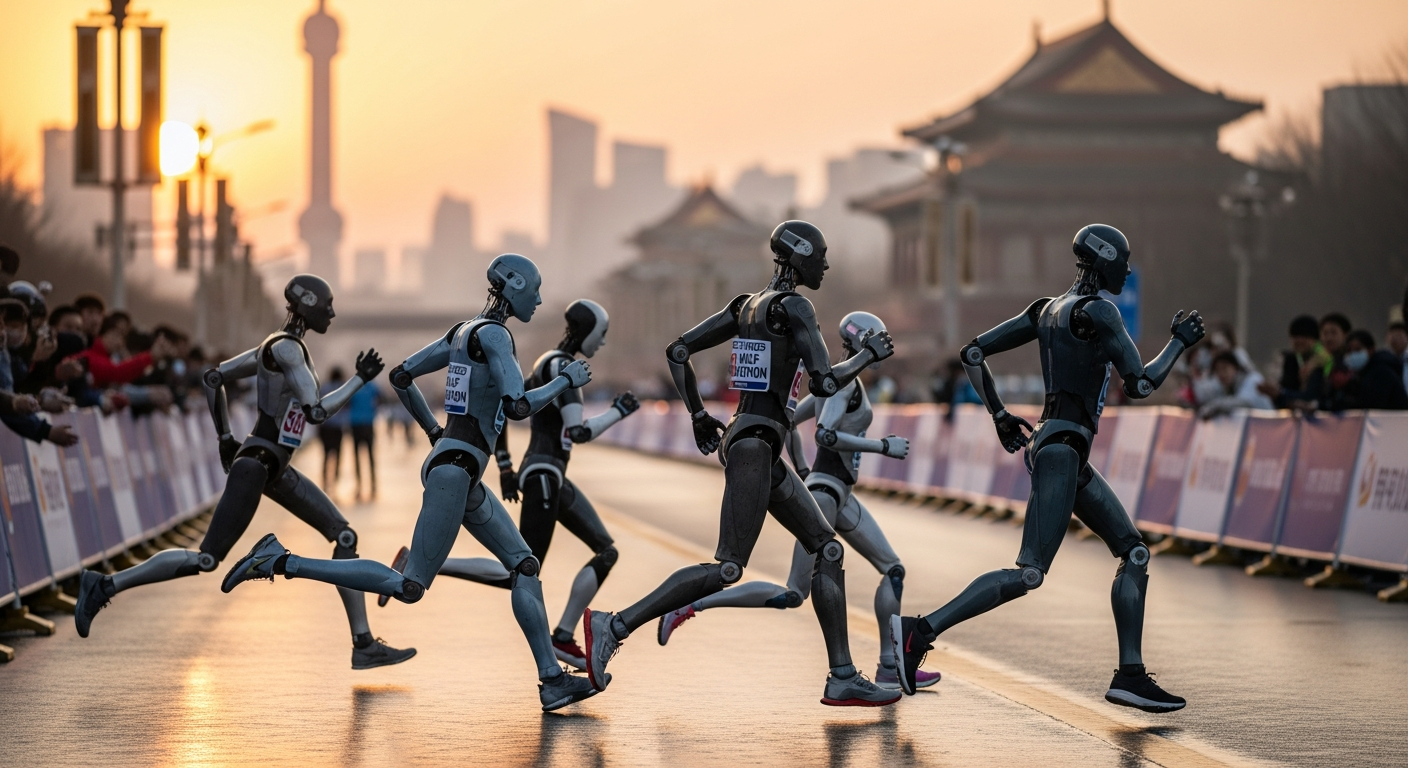
Beijing's Humanoid Robot Half-Marathon: Tiangong Ultra Wins the World's First Bot vs. Human Road Race
The world's first half-marathon for humanoid robots ran in Beijing in April 2025 — Tiangong Ultra finished the 21.1km course in 2 hours 40 minutes. Here is what happened, who competed, and why it matters for robot athletics.
By RSW Editorial · April 19, 2025 · 10 min read · robot-athletes
On April 19, 2025, Beijing hosted the world's first half-marathon contested by humanoid robots running alongside human runners. Twenty-one bipedal machines lined up at the start in the Yizhuang district, and the winning robot — Tiangong Ultra, built by the Beijing Humanoid Robot Innovation Center — crossed the line of the 21.1 kilometer (13.1 mile) course in 2 hours, 40 minutes, and 42 seconds.
It was, by every reasonable measure, the most ambitious public test of bipedal robot endurance ever attempted. It was also a dose of reality: the human winner finished the same race in roughly 1 hour and 2 minutes. Robots are not catching humans on the road yet. But the gap is closing faster than most analysts expected even two years ago, and the Beijing event made the trajectory tangible.
What Happened on Race Day
The race ran on a closed road course through the Yizhuang economic-technological development zone in southeastern Beijing, set up alongside a parallel half-marathon for human runners. Each robot was permitted a small support crew, and crucially, each was allowed mid-race battery swaps. The rules were practical rather than purist: organizers wanted the robots to actually finish, and the regulations reflected the engineering realities of running a humanoid for two-plus hours.
Tiangong Ultra, the winning robot, is the latest iteration of the Tiangong open-source humanoid platform developed by the Beijing Humanoid Robot Innovation Center, a state-supported research consortium. Standing roughly 1.8 meters tall and built around a torque-controlled bipedal locomotion stack, Tiangong Ultra averaged a pace of about 7.9 km/h across the course — slower than a recreational human runner, but close to a brisk human jog and faster than a comfortable walking pace.
Twenty-one robots started. Six finished within the official six-hour cutoff. Several fell, several overheated, and several had support crews swap them out for backup units mid-course — a permitted but penalized maneuver. The DNFs were as informative as the finishers; what broke during a 21-kilometer continuous run revealed the actual reliability ceiling of current humanoid platforms.
How Tiangong Ultra Won
The gap between Tiangong Ultra and the rest of the field was not subtle — it finished more than half an hour ahead of the next robot. Three engineering choices appear to have made the difference.
Locomotion gait optimization. Tiangong Ultra used a longer stride and a more upright posture than most of the competition, which improved its energy-per-meter compared to robots running shorter, more cautious gaits. This is the same trade-off that distinguishes elite human distance runners from recreational ones, and it transferred to bipedal hardware in roughly the way the Beijing engineers expected.
Battery management and swap discipline. The robot's support crew executed clean battery hot-swaps at planned intervals, minimizing the time penalty. Several competing teams had to make unplanned swaps after underestimating the actuator load on hilly sections, which cost them minutes that compounded over the course.
Conservative thermal limits. Tiangong Ultra was tuned to run below the actuator and battery thermal limits that took out at least three other competitors before kilometer ten. This is the same lesson that took human marathoners decades to internalize: the fastest sustainable pace beats the fastest momentary pace.
For a comparison point on the upper bound of bipedal sprint speed, see our Unitree H1 bipedal speed record breakdown. The H1 has clocked sprint speeds well above what any robot in the Beijing field sustained — but speed and endurance are very different problems for humanoid hardware.
Who Else Competed
The 21-robot field was a snapshot of the current Chinese humanoid landscape, with a few international entries. Notable competitors included:
- N2 from Noetix Robotics — a smaller-format humanoid that finished the course but well behind the leaders.
- Tien Kung-class entrants from multiple research labs — variants of the same open-source Tiangong platform, several of which finished but with significant time penalties from falls and battery swaps.
- Industrial logistics-derived bipeds — repurposed warehouse humanoids from Chinese manufacturers attempting to validate locomotion stacks under real road conditions.
The race was open to international entrants, but most of the high-profile Western humanoid programs — Boston Dynamics, Figure, Apptronik, 1X, Agility — did not enter. Several reasons have been cited publicly, including export-control complications, the readiness gap between research humanoids and commercial bipeds, and the simple fact that Western programs are currently focused on logistics-deployment milestones rather than public endurance demonstrations.
For the state of those Western programs, our coverage of the Boston Dynamics Atlas Electric platform and the Figure AI/OpenAI integration demo covers the current capability landscape. For practical road-running benchmarks from a US-built humanoid, see our breakdown of Agility Robotics' Cassie 5K run, which set the previous reference point for sustained bipedal road performance before Beijing pushed the distance to 21 kilometers.
What This Tells Us About Humanoid Robotics in 2025
The Beijing half-marathon was as much a stress test as a race, and the results carry several signals worth reading carefully.
Endurance is harder than speed
Humanoid robots have been able to sprint for years. Sustained running is much harder. Continuous bipedal locomotion stresses actuators, batteries, thermal systems, and balance controllers in ways that one-minute demos do not. The fact that only six of twenty-one robots finished a 21-kilometer course is evidence that endurance remains the bottleneck.
Battery technology is the limiting factor
Every team in the field had to plan for mid-race battery swaps. The energy density of current lithium chemistries simply does not support a humanoid running for two-plus hours on a single pack. Until solid-state batteries reach commercial maturity — or until actuator efficiency improves significantly — battery swaps will remain part of the bipedal endurance playbook.
Falls and recovery are the real-world failure mode
The most telling moments of the race were the falls. Several robots toppled at curbs, on lane markings, or simply because their balance controllers could not handle a small surface anomaly. The robots that recovered automatically and continued — or were quickly righted and reset by their support crew — finished. The ones that did not, did not. Recovery from falls is now arguably the most important reliability metric for outdoor humanoid deployment.
Public road conditions expose the simulation gap
Many humanoid locomotion stacks are trained primarily in simulation, and Beijing exposed the gap between simulated and real-world surfaces. Lane paint reflectivity, drain-cover textures, and minor camber changes all caused problems for robots whose balance controllers had been validated mostly indoors. The platforms that finished tended to have either real-world-trained policies or robust enough fallback controllers to handle the unexpected.
Engineering Lessons for Builders and Researchers
For people building humanoid platforms — whether at a research lab, a startup, or a serious garage program — the Beijing race produced a free training set of lessons.
Plan for thermal headroom. The teams whose robots overheated were running at or near peak actuator current for long stretches. The teams that finished were running at 60-70% of peak with deliberate thermal margin.
Validate your fall-recovery sequence outdoors. Indoor fall-recovery testing is necessary but not sufficient. Asphalt, curbs, and uneven concrete behave differently than gym floors.
Design the support workflow before the race. The hot-swap battery procedure, the diagnostic checklist, and the chain of command for stop/continue decisions all had measurable impacts on finishing positions. The teams that practiced support workflows beat the teams that improvised.
For component-level upgrades — high-torque servos, joint actuators, IMU stacks, and battery packs — builders can source humanoid actuator kits and locomotion components at hobbyist-accessible price points. The DIY humanoid space has matured rapidly in the past two years, and the parts ecosystem now meaningfully overlaps with what professional teams use at the smaller weight classes.
Frequently Asked Questions
Who won the Beijing humanoid half-marathon?
Tiangong Ultra, built by the Beijing Humanoid Robot Innovation Center, won the world's first humanoid half-marathon on April 19, 2025, with a finishing time of 2 hours, 40 minutes, and 42 seconds. Twenty-one robots started the race; six finished within the official six-hour cutoff.
How does the robot finishing time compare to human runners?
The robot winner finished in roughly 2:40, while the human winner of the parallel half-marathon finished in approximately 1:02. Recreational human runners typically finish a half-marathon in 2:00-2:30, putting Tiangong Ultra's pace below most adult human runners but well above a walking pace.
Were the robots fully autonomous?
The robots ran with onboard control and onboard power, but human support crews were permitted for battery swaps, fall recovery in some cases, and emergency stops. The robots executed their locomotion autonomously; the surrounding race operations were not.
Will there be more humanoid road races?
Organizers have publicly indicated interest in repeating the event in 2026 and expanding the format, potentially to a full marathon distance and to a wider international field. Several other cities — both in China and elsewhere — have been mentioned as candidates for similar events, though no firm 2026 schedule has been published.
What Comes Next
The Beijing half-marathon is the kind of public engineering milestone that other research consortia will want to match. Expect more sustained-locomotion demonstrations in 2026, with more international participation, longer distances, and tighter rules around support-crew intervention. Expect the gap between robot and human pace to keep narrowing — not because robots will out-run humans soon, but because every season of public endurance testing reveals more about what breaks under load and how to fix it.
For ongoing coverage of competitive robotics and the platforms shaping the next race, follow our robot athletes section and our sourced performance records.
The year-over-year comparison
Read our 2025–2026 humanoid endurance breakdown for the winning times, autonomy distinctions and engineering questions behind the improvement.