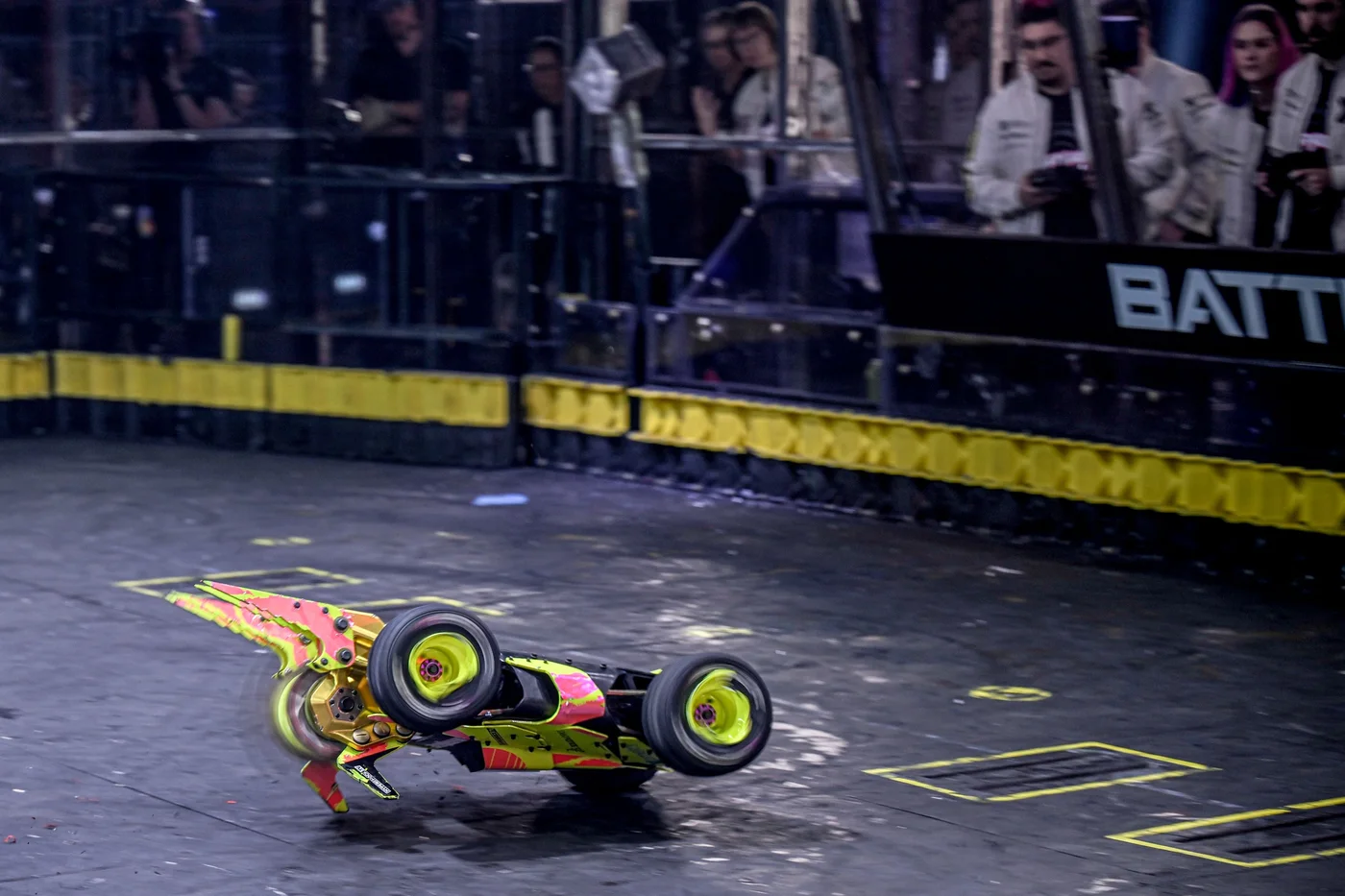
The Death of the Ground Game? Why Combat Robot Forks Still Matter
Forks and wedgelets can decide how a weapon meets its opponent, but ground clearance creates compromises in traction, reach, strength and arena mobility.
By Riley Cross · September 26, 2026 · 3 min read · combat-robotics
In robot combat, the first contact often decides what the weapon can do next. A fork or wedgelet that reaches underneath an opponent may change its orientation, reduce useful wheel contact and present part of its chassis to a spinner.
That is the ground game: control of the contact geometry near the floor. It remains important, but a low leading edge is not a universal solution.
Our BattleBox arena overview explains why the fighting environment matters. Floors, boundaries and hazards are part of the mechanical problem, not a neutral background.
Getting underneath changes the engagement
An inclined surface can redirect contact forces. If it lifts part of the opponent, the opponent may lose useful traction or meet the weapon at a less favourable angle.
The outcome depends on both robots' speed, mass distribution, wheel grip and approach angle. A static wedge diagram cannot capture the full dynamics of two moving machines.
Forks also help position the opponent relative to a vertical weapon. But they do not guarantee a hit: an opponent can turn away, attack from the side or damage the leading structure before the desired engagement develops.
Long reach has a structural cost
A longer fork can reach a chassis earlier, but a force near its tip produces a larger bending moment at its mounting point. The attachment, hinge and surrounding frame must support that load.
Adding material increases strength in some situations but consumes mass and may alter mobility. Material choice, heat treatment and geometry have to be considered together; naming a steel grade is not enough to establish performance.
Replaceability is a separate advantage. A sacrificial part can protect a more expensive structure only if it fails in a predictable way and the replacement process is practical.
Hinges trade rigidity for floor following
An articulated wedgelet can follow local floor variation more readily than one rigid assembly. Multiple segments may preserve some useful contact when another segment is displaced.
They also add joints, stops and mounting hardware. Dirt, deformation or impact can prevent a segment moving as intended. The design needs to work after damage, not only on a smooth workshop surface.
Very low clearance can create another failure mode: the robot can catch on an irregularity or become high-centred, reducing its own mobility.
Opponents can change the question
A horizontal weapon may attack extended forks instead of engaging in a straight contest to get underneath. An unusually tall or flexible chassis may reduce the value of conventional ground-game geometry.
Driving also changes the matchup. A well-timed turn can deny the direct approach a fork system was designed to exploit.
This is why there is no single best fork length or bevel for every opponent. The useful configuration depends on the weapon, the robot's drive performance and the permitted arena conditions.
Inspection and setup checklist
- Confirm the configuration complies with the event's current rules.
- Check mounting integrity, hinges and travel stops after each fight.
- Test controlled movement across representative floor irregularities.
- Inspect whether damage changes weapon clearance or wheel contact.
- Record which configuration was used against which opponent.
The ground game is not dead. It has become a broader trade-off between contact advantage and reliable operation.
Reporting basis
This is a mechanical and tactical explainer, not a report of a newly introduced universal fork restriction. Builders should consult the current BattleBots rules and entry documents for their event rather than assume that a televised configuration is permitted everywhere.
Cover photograph: End Game versus HyperShock, Jon C. R. Bennett / BattleBots, published by Team HyperShock.