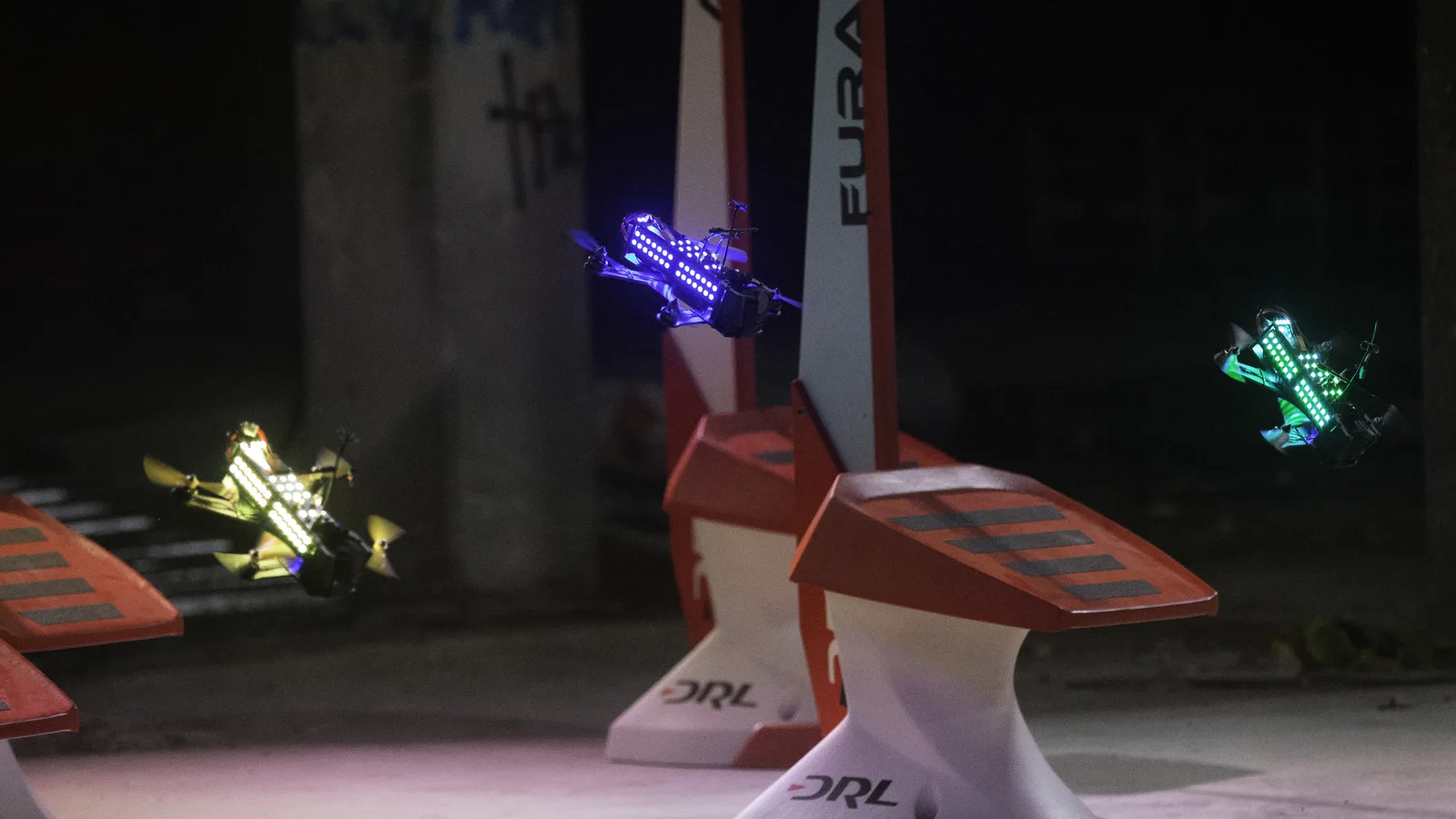
From Warehouse Hobby to Global League: The Surprising Business of Drone Racing
A decade from empty warehouses to a $250M acquisition, televised global leagues, and AI pilots racing humans. Here's the full story of how drone racing became a serious business.
By Sam Nakamura · April 15, 2026 · 9 min read · fpv-racing
It started in empty warehouses with hobbyists racing homemade quadcopters for fun. A decade later, drone racing is a televised global sport with professional leagues, eight-figure funding rounds, and increasingly, fully autonomous AI competitors racing where humans once flew alone.
The DRL Story
The Drone Racing League (DRL), founded in 2015 and based in New York, was built around a clear thesis: capture the visceral thrill of motorsport in a format that didn't need a racetrack, a stadium, or even daylight. Pilots fly custom-built drones at speeds up to 90 miles per hour through tight, obstacle-filled 3D courses, watching through first-person-view goggles that put viewers directly in the cockpit alongside them.
The league has broadcast on NBC Sports, Sky Sports, and FOX Sports Asia, built its own gaming platform (DRL SIM), and launched DRL Academy to grow the next generation of pilots. In 2024, DRL was acquired by Infinite Reality for a reported $250 million — a clear signal that investors see real commercial weight behind the sport. Total funding across DRL's history exceeded $72 million before the acquisition.
The Grassroots Layer
Beneath the professional league sits a much larger grassroots ecosystem. MultiGP, the largest drone racing community in the world, runs hundreds of local chapters across the United States, Australia, Asia, South Africa, Europe, and South America, all feeding into a structured path from local meetups to its flagship International Open — often described by participants as "the Olympics of drone racing."
MultiGP's model is the opposite of DRL's: community-driven, local-first, and explicitly designed to bring beginners into the sport through proximity rather than broadcasting. Both models exist in productive coexistence; the grassroots ecosystem feeds the top-level talent pipeline.
The DCL Hybrid Model
A third model is reshaping what the sport can even look like. The Drone Champions League (DCL) blends real-world racing locations with "Digital Twin" mixed-reality technology, effectively merging the physical and virtual racing worlds. DCL has also expanded internationally in unexpected directions — its Saudi DCL partnership with Tuwaiq Academy launched the first national drone racing competition in Saudi Arabia, culminating in a live final at the LEAP 2026 technology conference in Riyadh.
DCL also runs its own PC and console simulation game, giving it a direct-to-consumer entertainment product independent of live event scheduling.
The AI Frontier
The newest and arguably most consequential shift is the arrival of autonomous AI competitors. Events like the A2RL Drone Championship in Abu Dhabi now field fully autonomous drones — using only basic onboard sensors — racing both against each other and directly against elite human pilots.
Defense technology company Anduril has gone a step further, launching its own AI Grand Prix in 2026 specifically to challenge university teams and independent engineers to build autonomy software capable of outracing the best in the world — using identical hardware, with success determined purely by code. The competition directly mirrors what the defense and logistics industries need: perception and navigation software that performs under real-world pressure, with consequences for failure.
Where It Goes
What began as a niche hobby has become a genuine proving ground for autonomous systems technology, a televised spectator sport, and a serious investment category in its own right. The most interesting question isn't whether drone racing grows — it will — but whether the AI pivot makes the sport more or less appealing to general audiences who've watched the human-machine drama unfold in real time.
FAQs
How much has the Drone Racing League raised in funding? DRL raised over $72 million across its funding history and was acquired by Infinite Reality in April 2024 in a deal reportedly valued at $250 million.
What's the difference between MultiGP and the Drone Racing League? MultiGP is a grassroots, community-driven organisation with hundreds of local chapters worldwide, while DRL is a polished, broadcast-focused professional league — think amateur leagues versus a televised professional circuit.
Is drone racing an Olympic sport? Not currently. Drone racing remains outside the official Olympic programme, though its rapid commercial and technological growth has sparked ongoing discussion about future recognition.
Why are defense companies like Anduril getting involved in drone racing? Autonomous drone racing serves as a high-visibility, competitive testing ground for the same perception, navigation, and control software relevant to broader commercial and defense drone applications.