The Humanoid Biomechanics Breakdown: Understanding the 2.88-Metre Jump
A reported 2.88-metre humanoid high jump raises important questions about launch energy, body configuration, landing control and fair record comparisons.
By Riley Cross · October 4, 2026 · 3 min read · robot-athletes
#humanoid#hardware#world-record
A humanoid clearing a high bar is an impressive demonstration. Understanding it requires more care than comparing a single height with a human record.
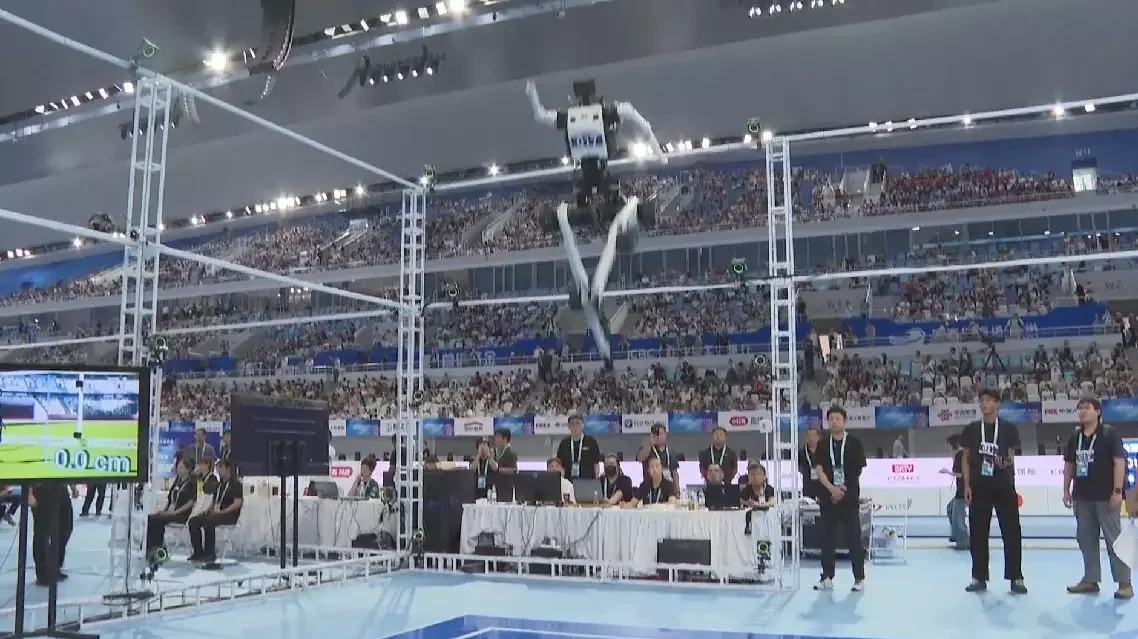
Coverage of the opening of the second World Humanoid Robot Games in Beijing reported a 2.88-metre standing high jump during a demonstration ahead of the opening ceremony. That is the headline result. It does not, by itself, reveal how far the robot's centre of mass rose, how its actuators were built or what assistance and landing conditions applied.
Our World Humanoid Robot Games sprint report places the demonstration alongside the wider event. This article separates the reported clearance from the biomechanics needed to explain it.
Clearance height is not centre-of-mass rise
A robot begins with its centre of mass above the floor. It may crouch before take-off and change its body configuration while airborne. Tucking its legs can help clear a bar without lifting every part of the machine to the same height.
The simple ballistic relationship is v = √(2gΔh), where Δh is the rise of the centre of mass after take-off, not the bar's height above the floor. Substituting 2.88 metres directly into that equation would only be valid if that value were the measured centre-of-mass rise.
The same distinction applies when comparing a robot demonstration with human high jumping. Running approaches, take-off technique, body dimensions and competition rules differ. A higher bar does not establish equivalence between the events.
Power and energy answer different questions
The gravitational energy needed to raise a mass is approximately m × g × Δh. The actuator must provide that energy, plus losses, within the available push-off time. Shorter delivery times demand greater average power.
This explains why an elastic element can be useful: energy may be accumulated before take-off and released during a shorter interval. But a video does not prove that a particular robot uses carbon tendons, a supercapacitor bank or a specific clutch arrangement.
Those are plausible design approaches, not documented components of the reported machine. A genuine teardown needs drawings, component information or instrumented measurements.
The ground contact has to remain controlled
Strong motors alone are insufficient. The feet must transmit force without slipping, while the joint movements maintain a useful direction of launch. A small asymmetry can produce rotation that complicates clearance and landing.
Useful measurements include foot-contact forces, joint positions, take-off velocity and body orientation. They should be synchronised: a force spike without a corresponding motion record cannot fully explain the jump.
Landing is a separate benchmark
The downward energy has to go somewhere. Joint motion, structural compliance and damping can spread the impact over time, reducing peak loads. A hard landing may still damage bearings, transmissions or mounting points even when the robot appears upright afterwards.
A practical test should report the landing surface, recovery behaviour and inspection results after repeated attempts. A single successful clearance is not proof of durable operation.
What a credible test report should include
- Bar height, robot dimensions and take-off configuration.
- Calibrated video or motion measurements showing centre-of-mass movement.
- Whether the jump was autonomous, commanded, supported or tethered.
- Repeated attempts, failures and the definition of a successful landing.
- Published hardware information clearly separated from inferred mechanisms.
These measurements would turn a striking demonstration into a reproducible engineering benchmark.
Reporting basis
The height and demonstration setting are attributed to CGTN's opening-ceremony coverage. This is a source-based explanation, not an instrumented analysis of the robot or a claim of identical human and robot competition rules.
Cover photograph: World Humanoid Robot Games jumping coverage, via Bastille Post.