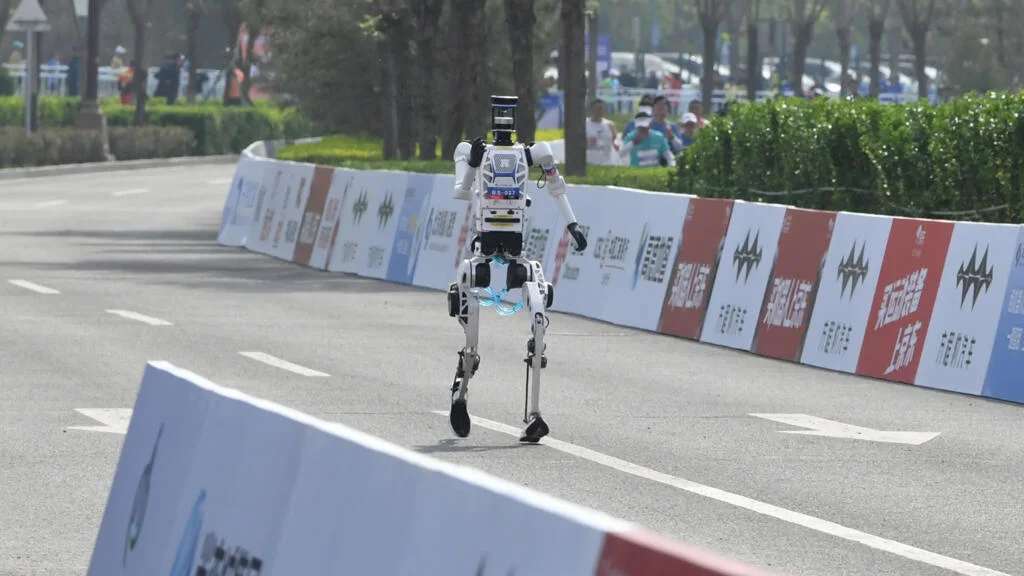
Bipedal Endurance Benchmarks: From 160 Minutes to a 50-Minute Half-Marathon
Beijing's winning humanoid half-marathon times changed dramatically between 2025 and 2026. Here is how to interpret the results without inventing hardware details.
By Riley Cross · October 1, 2026 · 3 min read · robot-athletes
#humanoid#speed#hardware#world-record
In 2025, Tiangong Ultra won Beijing E-Town's inaugural humanoid half-marathon in 2 hours, 40 minutes and 42 seconds. In 2026, Flash, from Shenzhen Honor Smart Technology Development, won with a reported autonomous-navigation time of 50 minutes and 26 seconds.
That is a striking change in the event's winning result. It is not a controlled experiment showing that the same robot became three times faster. Different machines, teams and competition arrangements are involved.
Our 2025 Beijing humanoid half-marathon report covers the first event. The year-over-year comparison is most useful when results, rules and hardware claims remain clearly separated.
What the numbers show
The two winning times correspond to approximately 160.7 and 50.4 minutes. Over a half-marathon distance of 21.0975 kilometres, they imply average speeds of about 7.9 km/h and 25.1 km/h respectively.
Those are derived averages across the event distance, not measured instantaneous top speeds. They also do not reveal how a robot's pace varied around corners, during interruptions or over the final kilometres.
Xinhua reported that only six of twenty teams finished the inaugural race in 2025. For 2026, it described more than one navigation category and a 1.2 coefficient applied to remote-controlled teams' finishing times. Comparisons must therefore specify whether a value is a raw elapsed time or the competition's classified result.
Endurance is more than battery capacity
A larger battery can hold more energy, but it also adds mass that the robot must carry with every step. The useful optimisation concerns the whole system: gait efficiency, actuator losses, structural mass, electronics consumption and the energy spent recovering from disturbances.
Battery chemistry alone cannot explain a result. A claim about semi-solid-state cells, a particular discharge rating or a team's battery changes needs documentation from that team. None should be inferred solely from the finishing time.
For meaningful comparisons, engineers often examine energy per unit distance and, where appropriate, cost of transport. Those measurements need an agreed system boundary and reliable energy logging.
Thermal performance determines sustainable pace
Motors, transmissions and controllers produce heat. A system that can sprint briefly may not be able to sustain the same gait for nearly an hour. Cooling, current limits and control decisions determine whether performance remains stable.
A useful endurance report would log component temperatures, voltage and current alongside speed. It would identify any thermal throttling or gait changes rather than describing cooling technology that has not been publicly documented.
The same principle applies to structural reliability. Repeated foot impacts and vibration can expose connector, fastener and bearing problems that are invisible in a short indoor demonstration.
Navigation is part of the athletic result
Road running requires maintaining direction while handling turns, surface variation and nearby activity. Autonomous navigation adds perception and planning requirements to the mechanical endurance problem.
That is why autonomy mode belongs next to the finishing time. External intervention, permitted servicing and penalties may materially affect how two results should be interpreted.
A useful endurance scorecard
- Distance and course conditions.
- Raw elapsed time and classified time, if different.
- Autonomy mode and permitted assistance.
- Interruptions, servicing and penalties.
- Energy used, temperature history and repeatability when published.
A scorecard like this creates a reference that remains useful after the headline passes.
Reporting basis
The winner, times, finishing-rate context and remote-control coefficient are reported by Xinhua's 2026 race coverage. This is desk analysis of published results, not testing of either robot's battery or cooling system.
Cover photograph: 2026 Beijing E-Town race, VCG / Reuters via France 24.