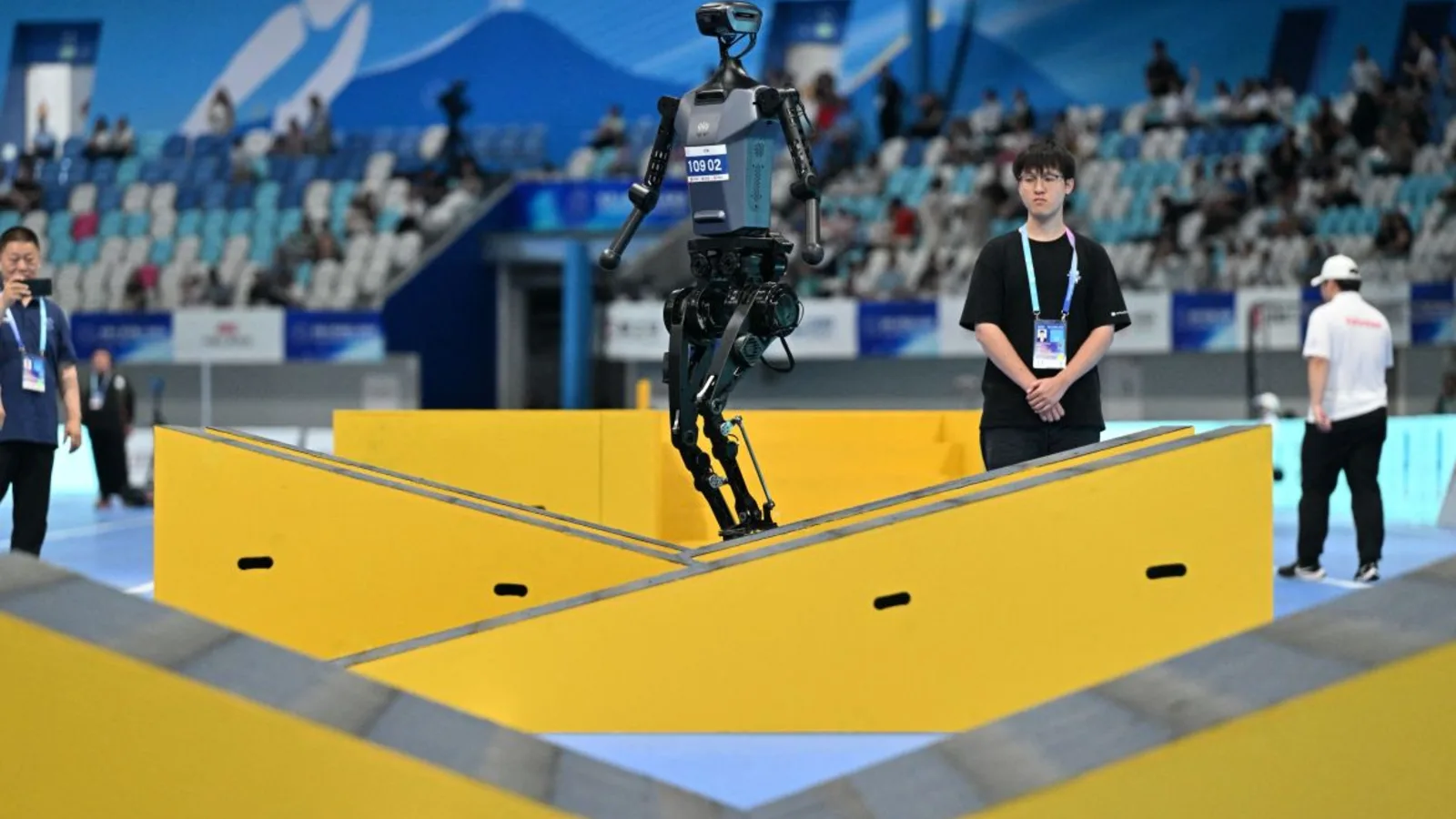
The World's First Humanoid Robot Games: Tumbles, Triumphs, and a Glimpse of the Future
Over four days at Beijing's National Speed Skating Oval, 500 bipedal robots from 280 teams across 16 countries competed in the inaugural World Humanoid Robot Games.
By RSW Editorial · August 22, 2025 · 7 min read · robot-athletes
The future arrived — wobbly, metallic, and occasionally face-first on the track — in Beijing in August 2025. The world's first-ever World Humanoid Robot Games took place at the National Speed Skating Oval, the same arena built for China's 2022 Winter Olympics. Over four days, more than 500 bipedal robots from 280 teams across 16 countries competed in 26 events spanning everything from a 100-metre sprint and a 1,500-metre run to kickboxing, five-a-side football, dance, and more.
Part Science Fair, Part Sporting Spectacle
The tone was unmistakable: part science fair, part sporting spectacle. Football matches saw small robots — roughly the size of seven-year-olds — shuffling around the pitch, frequently falling over in a heap or getting stuck in mechanical scrums. One robot competing in the 400-metre relay barrelled directly into a human operator, knocking them flat. The robot, to everyone's amusement, remained standing.
But amid the chaos were genuine flashes of capability. In the 1,500-metre race, Unitree Robotics' humanoids powered around the track at an impressive pace, taking gold and bronze. The winning time was 6 minutes and 34 seconds — nowhere near the human world record of 3:26, but a notable achievement for autonomous bipedal machines. The 100-metre sprint was won by the Tien Kung Ultra robot from X-Humanoid in 21.5 seconds.
Football Goes International
In the five-a-side football final, Tsinghua University's Huoshen Team beat Germany's HTVK+Nao Devils 1-0 — a genuinely competitive international result that highlighted how far robot football has come from its early experimental days. The match drew some of the loudest crowd reactions of the entire Games.
The event's 26 disciplines ranged across individual speed, endurance, precision, and team coordination. Some robots fell repeatedly and kept getting up. Others demonstrated a smoothness of movement that surprised even seasoned roboticists in attendance. The spread of difficulty — and failure — was itself revealing: these are machines pushing right at the edge of what is currently possible.
A Federation Is Born
At the closing ceremony, organisers announced the formation of the World Humanoid Robot Sports Federation — a governing body that signals an intent to formalise these competitions the same way human athletic federations structure their sports. It is an early but significant institutional step.
The second edition of the Games was confirmed for Beijing in August 2026. The machines are already training. If the improvement curve from 2025 to 2026 even partially matches the trajectory seen in other humanoid competitions — where performance has sometimes doubled year-on-year — the 2026 Games could look almost unrecognisable compared to the inaugural edition.
Watch this space.