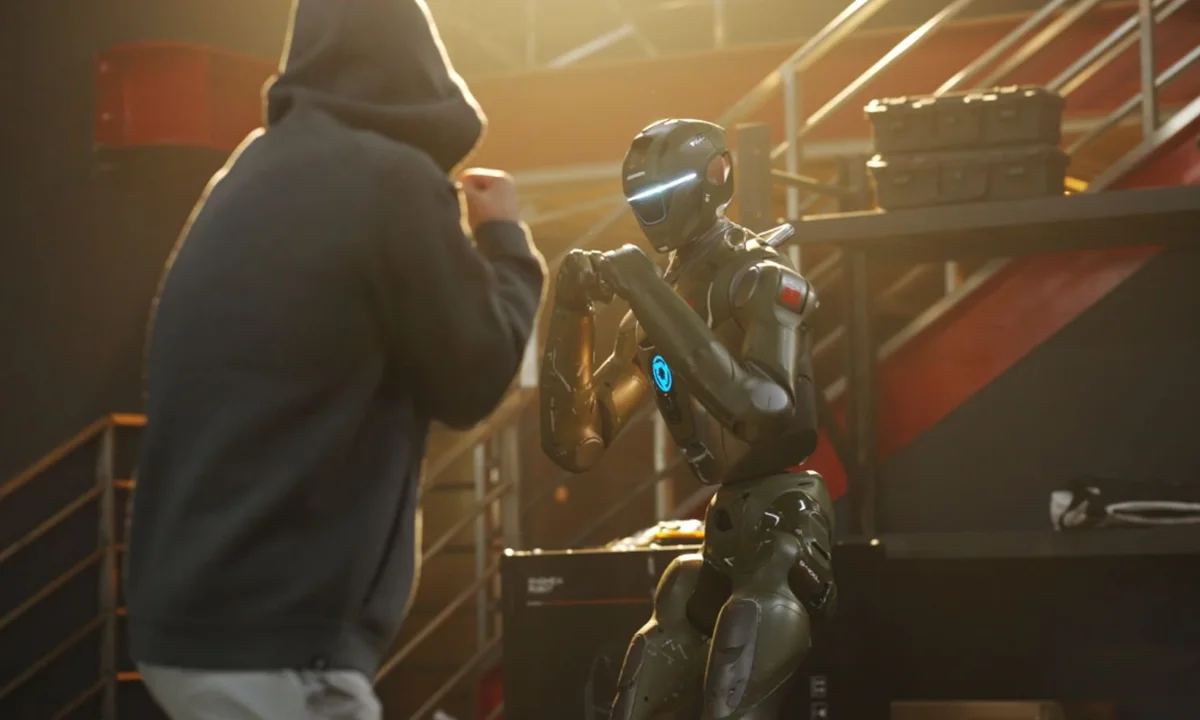
Inside the URKL Belt Race: The Engineering Demands of Humanoid Impact
EngineAI's humanoid combat competition puts balance, impact tolerance and serviceability under pressure. Here is what the published tournament structure actually establishes.
By Riley Cross · September 29, 2026 · 3 min read · combat-robotics
#humanoid#combat#hardware#championship
Humanoid combat turns locomotion into a contact problem. A robot may balance well while walking alone and still struggle when a strike, shove or fall changes its motion faster than its controller can compensate.
EngineAI's published competition overview provides a concrete framework for that challenge. It describes qualifying, group and double-elimination finals stages, with technical development based on the T800 platform subject to organiser approval.
Our URKL league introduction covers the broader launch. This article looks at the engineering questions teams must address, without treating unpublished internal hardware as a verified teardown.
What the published structure establishes
The official overview sets out an online preliminary selection, offline stages and a group stage scheduled for September–October 2026, followed by finals scheduled for November–December. It also specifies teams of three to ten members and requires technical capability and an approved development proposal.
Those are organiser-published plans. They are not confirmation of a completed championship, a particular belt holder or the outcome of every scheduled match.
The organiser explicitly prohibits dangerous modifications and malicious attacks. That makes compliance a design constraint, not an administrative detail to address after construction.
Balance under contact
An external impact changes linear and angular momentum. A humanoid may need to step, change its posture or reduce joint stiffness to avoid transmitting the entire disturbance through a rigid mechanism.
Compliance can be mechanical, controlled in software or a combination of both. More compliance is not automatically better: excessive yielding may compromise stance or reduce the precision of a commanded action.
Useful testing measures how the robot responds to a repeatable disturbance. Video highlights alone do not establish recovery margins, control latency or the internal loads experienced by its joints.
The load path matters
A strike or fall travels through covers, mounting points, structural members and joints. Protecting a motor is only useful if the surrounding fasteners and bearing supports can survive the same load.
Designers need to consider both local protection and the way force moves through the whole chassis. Replaceable outer protection may improve maintenance, but it should not interfere with joint movement, sensing or the organiser's modification limits.
Exact alloy grades, gearbox designs and shock ratings should come from published platform documents or inspected parts. They cannot be assigned from the T800's appearance.
Repeated matches change priorities
A competition rewards a machine that returns to the field, not just one that survives a dramatic exchange. Teams need repeatable inspection procedures and a clear definition of when a component must be replaced.
The practical checklist includes joint play, structural deformation, wiring damage, sensor alignment and abnormal temperature. Logs can help distinguish a one-off impact from a developing fault.
Component and inspection checklist
- Structure: approved protective parts, mounting integrity and accessible inspection points.
- Actuation: thermal limits, overload protection and joint-condition checks.
- Sensing: calibration verification after impacts or falls.
- Power: secure retention, insulation and safe shutdown.
- Operations: documented maintenance, controlled test areas and an organiser-approved configuration.
This is an engineering checklist, not an official T800 bill of materials or a build instruction for modifying combat hardware.
Reporting basis
The tournament stages, team requirements and technical-approval conditions come from EngineAI's published competition overview. The impact discussion is general engineering analysis; no hands-on destructive testing or unpublished material specifications are claimed.
Cover photograph: T800 preparing for a demonstration with a human boxer, courtesy of EngineAI via Global Times.