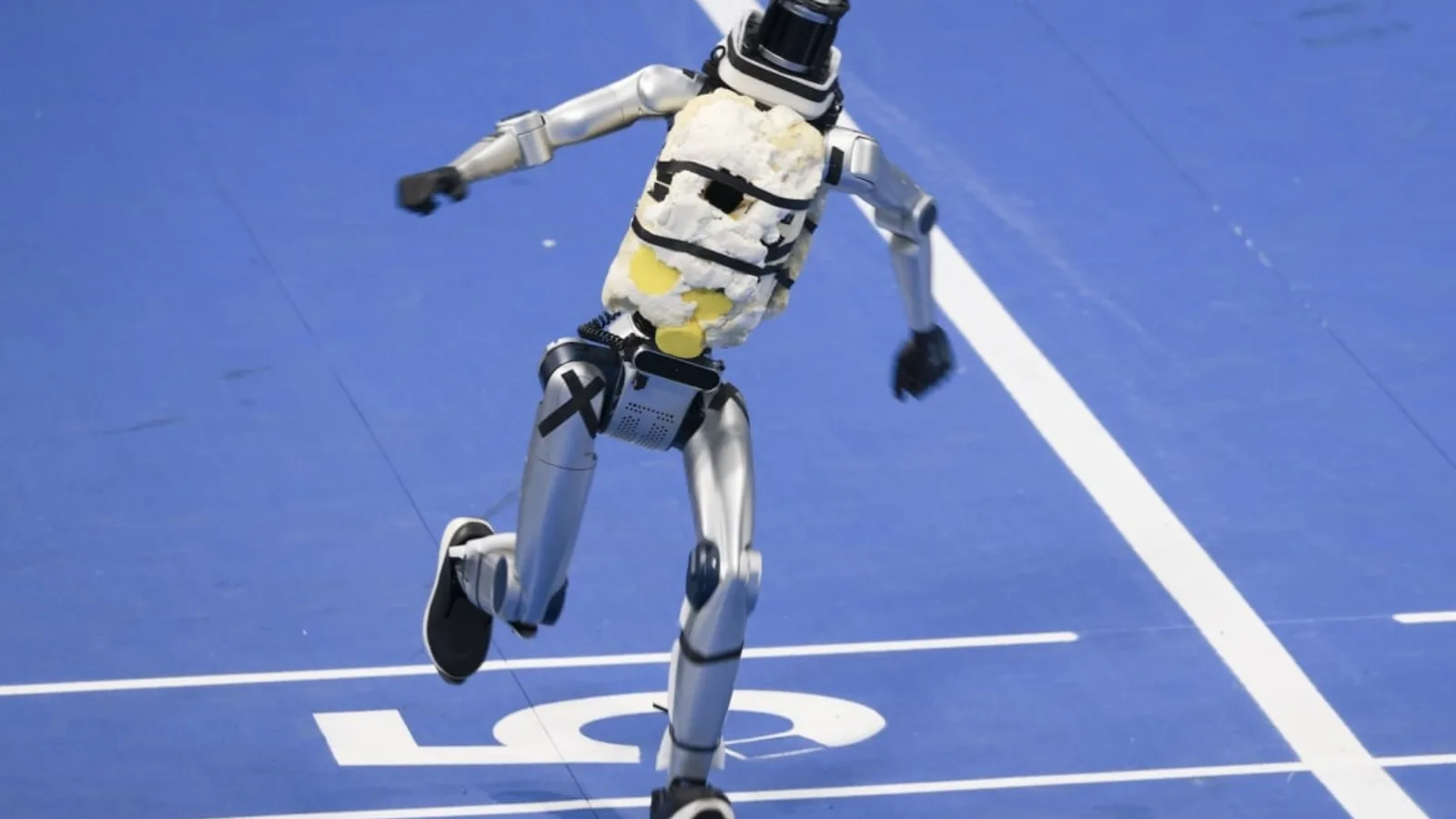
Robot Beats Usain Bolt's 100m World Record at the 2026 World Humanoid Robot Games
A humanoid robot named Lightning ran 100m in 9.32 seconds at Beijing's 2026 World Humanoid Robot Games, beating Usain Bolt's human world record.
By Riley Cross · September 10, 2026 · 5 min read · robot-athletes
Humanoid robotics crossed a symbolic line in Beijing this August: a robot ran the 100 meters faster than any human ever has. At the second World Humanoid Robot Games, held August 22–26, 2026 at Beijing's National Speed Skating Oval, a robot called Lightning, built by Honor, clocked the 100m sprint in 9.32 seconds — faster than Usain Bolt's long-standing human world record of 9.58 seconds set in 2009.
The Numbers That Made Headlines
Lightning's run wasn't an isolated fluke. Across the opening heats, robots posted times of 9.39, 9.34, and finally 9.32 seconds. In official competition, a second unit from X-Humanoid matched the milestone with a 9.39-second run and also broke the standing high jump record.
The improvement over the inaugural 2025 Games is stark. Last year's winning 100m time was 21.50 seconds; this year it was cut roughly in half. Robots from the Beijing Humanoid Robot Innovation Center, competing under the Tiangong banner, also posted record-breaking times in the 400m (38.15 seconds), the 1,500m (2 minutes 21.64 seconds), and the high jump — all faster than their respective human world records.
Scale of the 2026 Games
This year's Games were dramatically larger than the 2025 debut:
- 2,056 robots competed, up 311% year-over-year
- 666 teams took part, up 138% from 2025
- 16 countries and regions across six continents sent competitors
- 1,301 individual matches were held over five competition days
- Events spanned roughly 30 competitive sports plus around 20 real-world work scenarios, from medicine sorting to retail tasks
Organizers require full autonomy — no human operator "in the loop" — for marquee events like sprints, the 4x100m relay, soccer, tai chi, and gymnastics. Other disciplines, including the 400m obstacle course and kickboxing, still permit teleoperation, and robots that rely on a human controller receive only half credit under the Games' "Autonomy Weight Coefficient" scoring system.
Records Set Alongside the Sprint
The straight-line speed records grabbed the headlines, but they weren't the only benchmark broken. Separately, Unitree confirmed its "Superman" humanoid hit 12.66 meters per second and cleared a 2-meter jump — figures that also edge past recorded human top-end performance in those categories.
Not Every Event Went Smoothly
The Games were just as notable for where humanoid control still breaks down. Football, boxing, and weightlifting events exposed the current limits of balance and coordination in unstructured, contact-heavy competition, with several robots falling, colliding, or folding mid-event. It's a reminder that straight-line running — a highly controlled, repetitive motion — is a very different engineering problem from reactive, contact sports.
Why This Milestone Matters
Sprinting in a straight line is one of the most mechanically simple tasks a legged robot can perform, so beating a human world record here doesn't mean robots are broadly more athletic than people. What it does show is that humanoid locomotion has now crossed a meaningful biological threshold in controlled conditions — and that the pace of year-over-year improvement, a roughly 2x cut in sprint times between the 2025 and 2026 Games, is unusually fast even by robotics standards.
The 2026 World Humanoid Robot Games ran alongside the World Robot Conference 2026, which opened August 19 with more than 300 exhibiting companies, making late August the most concentrated public showcase of Chinese humanoid robot capability to date. Expect the third edition of the Games, along with rival properties like CyberHero and URKL, to push these numbers further in 2027.
For another benchmark in the same discipline, see how a humanoid broke the half-marathon world record.