Pneumatic vs. Flywheel Flippers: Where the Launch Energy Comes From
Stored gas pressure and rotating inertia offer different ways to power a combat robot flipper. The useful comparison is energy delivery, recovery, control and safety.
By Riley Cross · September 25, 2026 · 3 min read · combat-robotics
A flipper's job is to deliver a useful impulse at the right moment. Launch height is part of the spectacle, but contact timing, recovery and reliability determine whether the weapon helps win a match.
Pneumatic and flywheel-based mechanisms store energy in different forms. Gas pressure stores energy in a fluid system; a flywheel stores rotational kinetic energy. Neither architecture automatically produces the better fighting robot.
The contact geometry discussed in our combat robot ground-game guide is especially relevant: stored energy is of little value if the lifting arm cannot engage the opponent effectively.
Pneumatics: pressure must become useful motion
A pneumatic actuator converts a pressure difference into force across a piston area. The resulting mechanism then transforms that motion through an arm or linkage.
Pressure alone does not describe the launch. Gas flow, changing volume, losses and linkage geometry influence how force varies during the stroke. A system may generate substantial force but deliver it at an unhelpful point in the arm's movement.
Stored gas is finite. Depending on the design, repeated firings can change the available energy and recovery behaviour. A match plan must account for that rather than assume every launch remains identical.
Pressurised systems also require rated components, safe isolation and compliance with the particular organiser's inspection rules. They are not appropriate for improvised workshop experimentation.
Flywheels: energy is stored before contact
A rotating flywheel stores energy according to E = ½Iω², where I is rotational inertia and ω is angular velocity. A transfer mechanism connects some of that energy to the lifting action.
Because speed is squared, increasing it has a strong effect on stored energy—and on the demands placed on the rotating assembly. Bearings, containment, balancing and controlled shutdown are therefore central to the design.
A launch reduces the stored energy. The motor needs time and electrical power to restore it. Recovery is not unlimited simply because the energy source is a battery.
Energy-transfer losses and the behaviour of the coupling can also affect consistency. A nominal flywheel energy figure is not the same as energy delivered to an opponent.
Check the scale of the claim
As an idealised illustration, raising a 113-kilogram mass by three metres requires about 3.3 kilojoules of gravitational potential energy. The mechanism would require more input energy because of losses, and a real launch involves rotation and other motion.
This calculation does not specify a flipper design. It does show why a claim that every launch needs hundreds of kilojoules should be checked carefully rather than repeated for dramatic effect.
Compare the whole system
- Energy storage: how much usable energy is available within the allowed mass?
- Delivery: how consistently does the mechanism transfer energy through contact?
- Recovery: how quickly can it reset and replenish the available energy?
- Control: can the driver time the action effectively?
- Safety: how are stored energy and unexpected movement controlled?
- Serviceability: which parts wear, and how are they inspected between fights?
The best choice depends on the rules, team experience and mechanical integration. Other architectures, including hydraulic systems, should not be casually grouped with either category.
Reporting basis
This is a conceptual comparison, not a pressure-system blueprint or a tested ranking of particular robots. Consult the BattleBots rules and design documents for event-specific approval and safety requirements before considering any stored-energy weapon.
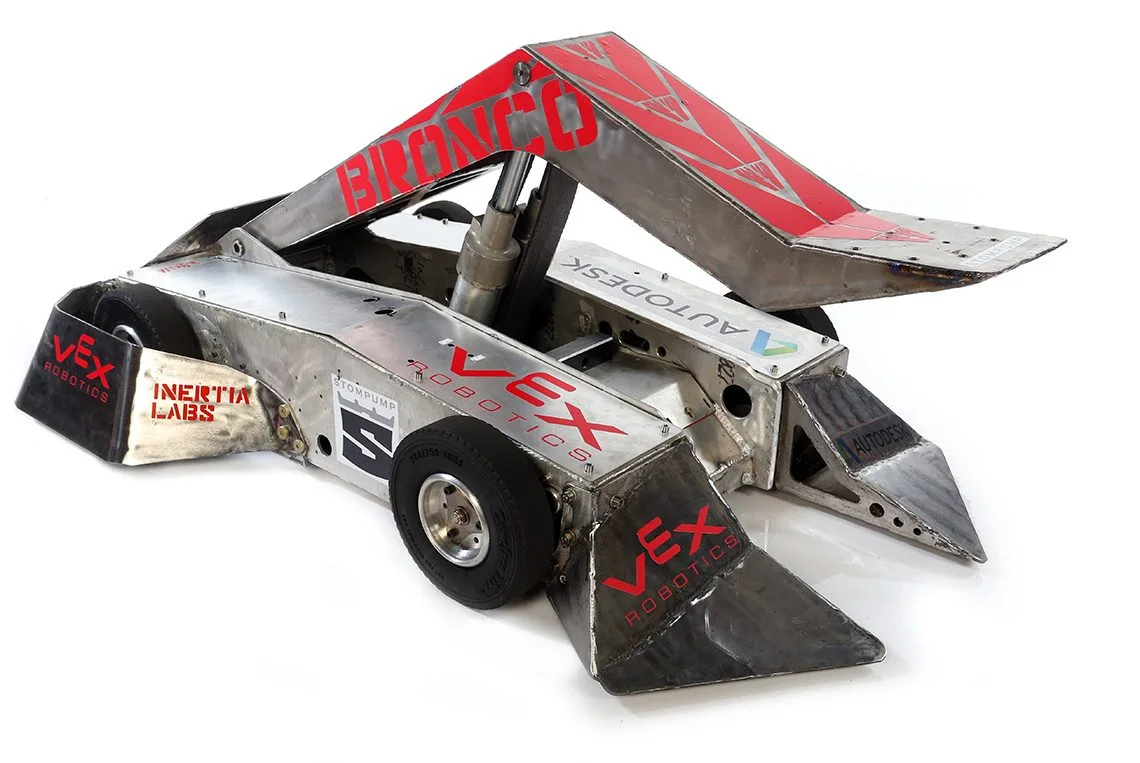
Cover photograph: Bronco, BattleBots 2018. The photograph illustrates a pneumatic flipper, not a flywheel comparison test.