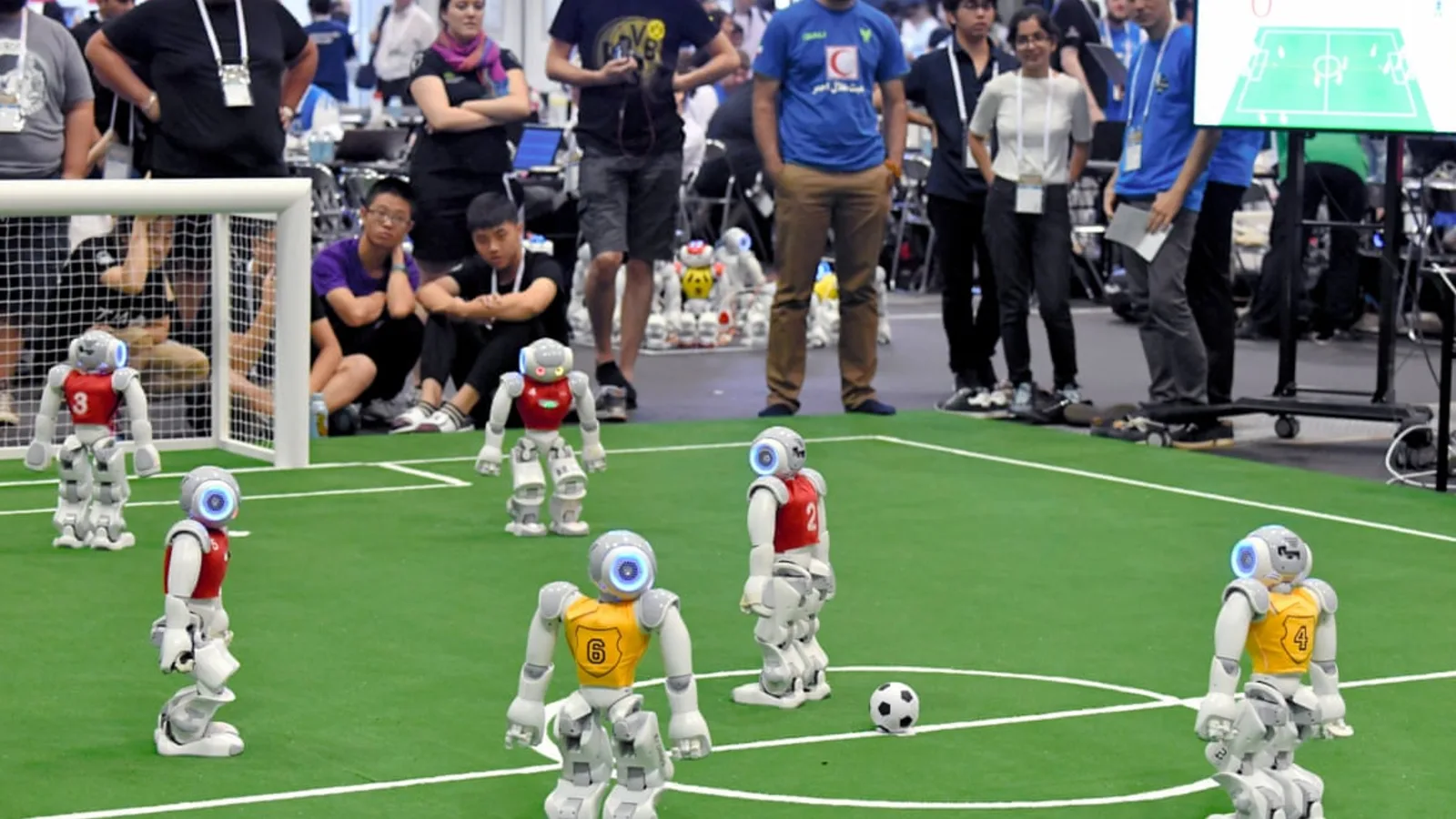
The 2050 Mission: Can Robot Footballers Really Beat the World Cup Champions?
In 1997 a group of roboticists bet that by 2050 autonomous humanoid robots would beat the FIFA World Cup winners. Nearly three decades later, RoboCup is still the most audacious long-term goal in the history of sport.
By RSW Editorial · January 20, 2026 · 8 min read · robot-athletes
In 1997, a group of roboticists made a bold bet on the future: by the year 2050, a fully autonomous team of humanoid robots would beat the reigning human FIFA World Cup champions in a fair game of football, played outdoors, under official FIFA rules. That ambition became RoboCup — and nearly three decades later, it remains one of the most audacious long-term goals in the history of science and sport.
The World's Largest Robotics Competition
RoboCup is now the world's largest robotics and AI competition, drawing more than 3,000 participants from dozens of countries each year. Its leagues span wheeled small-size robots competing 11-vs-11 in lightning-fast matches, standard-platform humanoids, mid-size machines, and full adult-sized humanoid leagues.
In 2026, the competition heads to Incheon, South Korea — its first time in Asia in years — running from June 30 to July 6 at Songdo Convensia.
ARTEMIS and the State of Play
The results at the top level are genuinely impressive. UCLA's RoMeLa lab, home of the ARTEMIS robot (which its creators say stands for "A Robot That Exceeds Messi In Soccer"), won the adult-size humanoid league at RoboCup 2024 in Eindhoven, claiming the team's sixth world championship. ARTEMIS features custom-designed electrically driven actuators engineered to mimic the behaviour of biological muscles — one of the key innovations that has steadily closed the gap between machine and human performance on the pitch.
The robot can sprint, dribble, and take shots with a level of coordination that would have been unthinkable just five years ago. Teams competing at the top of the adult-size league are no longer simply demonstrating that robots can play football — they are demonstrating tactical awareness, real-time adaptation to opponent behaviour, and increasingly natural movement patterns.
The Distance Still to Travel
But the 2050 target is still a monumental challenge. Current humanoid robots can play football, but they remain slower, less coordinated, and far less spatially aware than even amateur human players. They can't head the ball. They struggle to sprint, change direction, and read the flow of a game with the natural instinct a human develops over years of play.
The gap between the best RoboCup humanoids and a professional footballer — in terms of speed, agility, stamina, and game intelligence — remains enormous. Bridging it in 25 years would require breakthroughs not just in robotics hardware, but in real-time AI decision-making, computer vision, energy storage, and materials science simultaneously.
Why the Goal Still Matters
The RoboCup community argues that's not entirely the point. Much as the Apollo programme pushed forward everything from computing to materials science, RoboCup is a proxy for advancing AI, multi-agent coordination, computer vision, and autonomous decision-making. The football pitch is a measurable, standardised challenge that forces researchers to solve hard real-world problems under competitive pressure.
Win or lose in 2050, the robots are already making us smarter. And given the pace of improvement — 2026 machines are dramatically more capable than their 2020 equivalents — it would be unwise to bet too confidently against the machines.
The countdown is running.