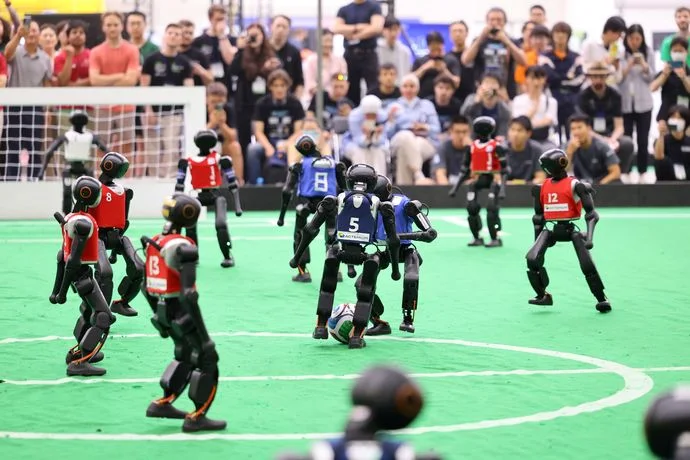
Inside RoboCup Incheon: The Coordination Challenge Behind 11-vs-11 Robot Soccer
RoboCup's first full 11-vs-11 humanoid match was a milestone. Here is why perception, role assignment and reliable teamwork become harder as teams grow.
By Riley Cross · October 6, 2026 · 3 min read · robot-athletes
On 5 July 2026, B-Human and HTWK Robots played a full 11-vs-11 humanoid soccer match at RoboCup in Incheon. The RoboCup Federation reported a 4–0 victory for B-Human, with both teams using robots designed by Booster Robotics.
The achievement matters because adding players changes the problem, not just the spectacle. Every robot must perceive the field, make decisions while moving and contribute to a team whose members never have perfectly identical information.
Our report on the Incheon match provides the event context. Here, the focus is the coordination problem that makes eleven-player robot soccer such a demanding benchmark.
More players create more uncertainty
A ball can be hidden behind a teammate. A robot's view of an opponent can disappear during a turn. Its estimate of its own position can drift as its feet slip or it recovers from a fall. Team-level decisions must therefore work with incomplete and sometimes conflicting observations.
The goal is not to give every robot an identical map at every instant. It is to maintain enough shared understanding for the next useful action: approach the ball, defend a space, receive a pass or avoid obstructing a teammate.
This is why local confidence matters. A robot should be able to distinguish a recently observed ball from an old estimate, and a strong position estimate from a guess.
Perception is a moving-camera problem
Humanoid cameras move with the body. Walking changes the camera's orientation; head movement changes what is visible; impacts can blur frames. Field markings and goals provide useful landmarks, but the perception system must relate them to the robot's current pose.
Sensor fusion can combine visual information with inertial readings and motion estimates. The relevant questions are the quality of the estimate and its uncertainty, rather than whether an article can attach an impressive-looking frame rate to it.
The Federation's match announcement does not document a universal event-camera, UWB or visual-SLAM architecture for the teams. Those technologies should not be described as established match hardware without team technical reports.
A team needs roles, not eleven ball chasers
An active attacker has to be selected while other players create space, cover defensive areas or support a possible pass. Common multi-agent approaches evaluate distance, orientation, estimated arrival time and the usefulness of alternative roles.
Communication helps, but it is not free or instantaneous. Messages can be delayed or lost. A resilient system needs sensible local behaviour when the newest team update is unavailable, rather than waiting indefinitely for agreement.
Role changes must also avoid oscillation. If two players continuously exchange the attacker role, neither may commit to the ball. A stable assignment policy balances responsiveness with persistence.
Hardware reliability is part of intelligence
Tactical software is only useful while the player remains functional. Recovering from a fall, maintaining joint temperature and preserving usable battery charge all affect the team's options.
The useful component checklist therefore includes cameras, onboard compute, inertial sensing, contact sensing, actuators and power management. It is not enough to list a processor's peak TOPS figure: software integration, cooling and power consumption determine what the robot can sustain.
What to measure next
- Ball-detection and localisation quality under motion and occlusion.
- Team-message delays and behaviour during communication loss.
- Successful passes, possession changes and role-switch frequency.
- Falls, recovery time and hardware interruptions.
- The autonomy and assistance rules used for each match.
Those measures would make a technical comparison more informative than the score alone. RoboCup's long-term 2050 ambition remains a much broader challenge than one historic match.
Reporting basis
The match details come from the RoboCup Federation's official announcement. The engineering discussion describes general coordination challenges, not unpublished implementation details or a claim that the teams played a 90-minute FIFA-regulation match.
Cover photograph: RoboCup Federation, Incheon match gallery.