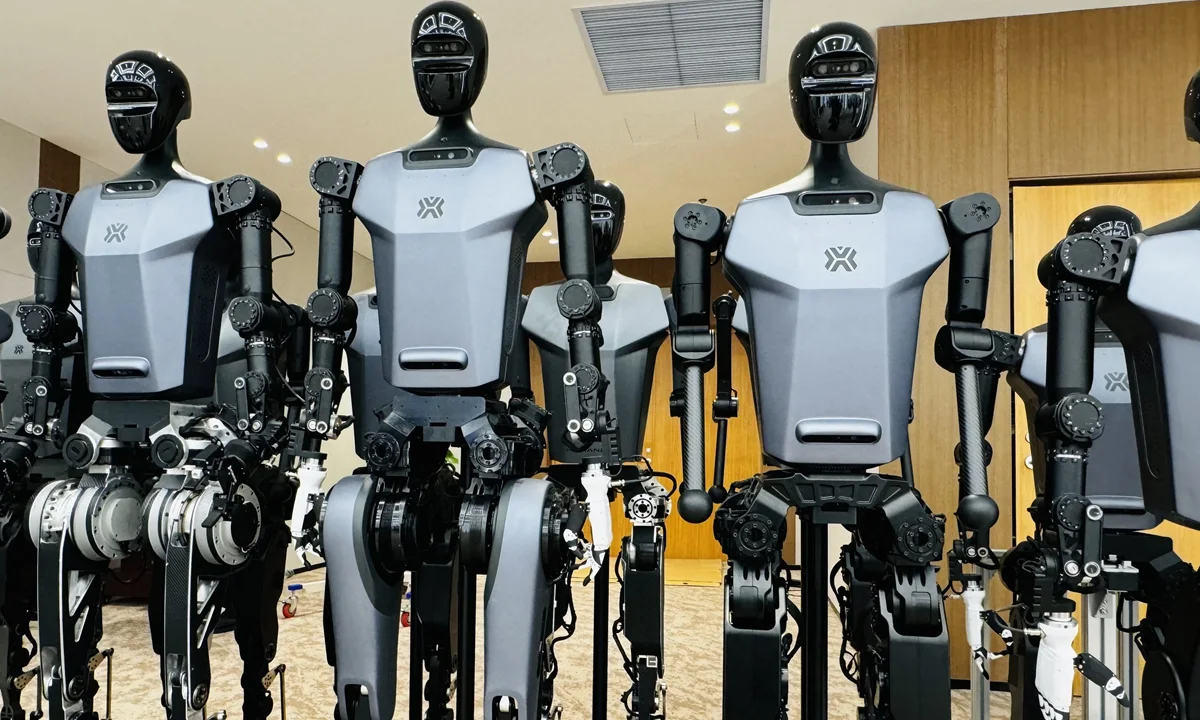
Tiangong Ultra vs. Unitree Superman: What Robot Sprint Records Really Measure
A practical engineering comparison of humanoid sprinting, from actuator trade-offs to the difference between peak speed and a timed 100-metre race.
By Riley Cross · October 7, 2026 · 3 min read · robot-athletes
Humanoid sprinting has reached a point where the most interesting question is no longer simply whether a robot can run. It is whether its performance can be measured fairly, repeated reliably and sustained without falling, overheating or running out of track.
Unitree's Superman announcement put that question into sharp focus. The company reported a top speed of 12.66 metres per second and a two-metre standing high jump in August 2026. Xinhua reported those figures as manufacturer claims, not as an independently certified 100-metre race result. Tiangong Ultra, meanwhile, has become an important reference point through public running and endurance demonstrations.
Our earlier Unitree Superman report covers the announcement. This analysis examines what an engineering comparison between those platforms can—and cannot—tell us.
Peak speed is not a 100-metre time
Dividing 100 metres by 12.66 m/s gives approximately 7.90 seconds. That is a useful arithmetic illustration, but not a race prediction: it assumes the robot begins at full speed and maintains it for the entire distance. A real timed race includes acceleration, possible speed variation and a precisely defined finish.
A credible record needs the start procedure, timing equipment, course length, surface, permitted assistance and autonomy mode. A brief speed measurement and a standing-start 100-metre result should therefore appear in separate columns, not on the same leaderboard.
What makes a fast biped?
Forward speed combines step length and step frequency, provided those terms are defined consistently. Longer steps can increase distance covered, but they also increase the demands on foot placement, joint motion and landing control. Faster stepping reduces the available time to detect contact and correct balance.
The actuator must supply enough joint torque without making the leg too heavy. Reduction gearing can increase output torque, but it also changes reflected inertia, friction and backdrivability. A low-ratio drive may respond more readily to an impact; a higher-ratio system may offer different packaging and torque advantages. Neither architecture wins automatically.
Public performance announcements do not establish the exact gearbox ratios, motor currents or control-loop frequencies inside both robots. Those details require manufacturer documentation or an instrumented teardown. Assigning precise values from a running video would be speculation.
Traction, heat and stopping matter too
The robot can only accelerate as strongly as its contact with the track allows. Foot material, surface condition and the timing of push-off all influence the usable ground reaction force. A powerful actuator cannot recover traction that is not there.
Repeated runs also expose thermal limits. Peak power available for one short burst is different from continuous power over a session. A useful test would log motor and controller temperatures, battery voltage and gait changes across repeated attempts.
Stopping should be part of the benchmark. At sprint speed, a small sensing or control delay becomes meaningful forward travel, while deceleration requires controlled foot placement rather than simply switching off the motors.
A comparison checklist for builders
- Actuation: published torque-speed curves, joint mass and continuous thermal limits.
- Sensing: encoder accuracy, inertial measurements and ground-contact detection.
- Power: voltage sag and protection behaviour under repeated acceleration.
- Timing: measured distance, start convention and independently calibrated equipment.
- Safety: a documented run-off zone, controlled stopping procedure and supervised testing.
These are evaluation categories, not a verified bill of materials for either platform. The strongest future comparison will publish raw timing and repeatability data alongside the headline speed.
Reporting basis
This is source-based engineering analysis, not a hands-on teardown. The Superman figures are attributed to Unitree through Xinhua's August 2026 announcement report. A sub-nine-second theoretical calculation should not be labelled a recorded sprint.
Cover photograph: Tiangong on display, published by Global Times; illustrative platform photograph, not a Superman speed trial.