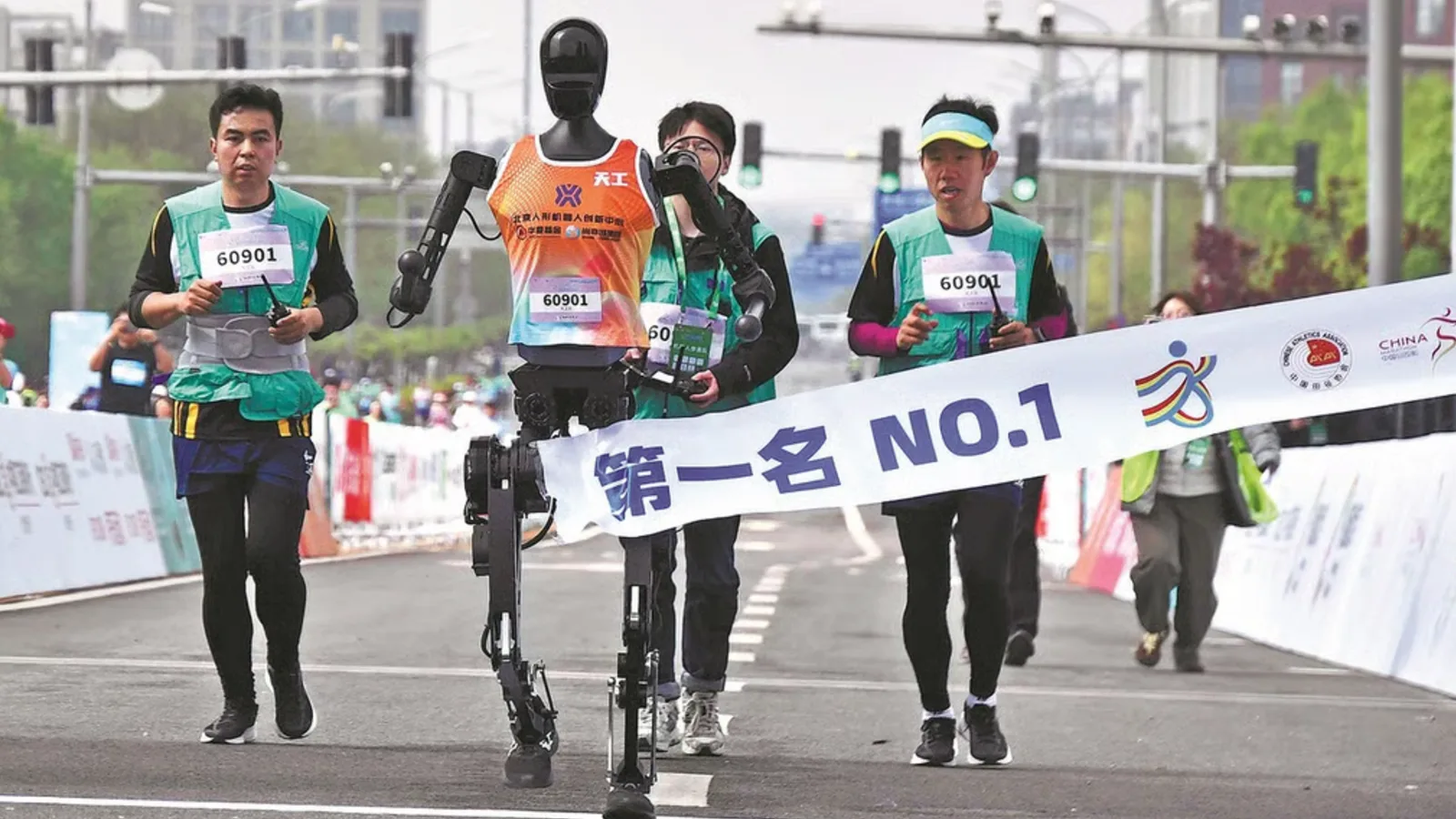
Unitree’s “Superman” Robot Confirmed: 12.66 m/s Speed and a 2-Metre Jump
Unitree confirmed its Superman humanoid reached 12.66 m/s and cleared a two-metre jump, edging past recorded human top-end speed.
By Riley Cross · August 30, 2026 · 4 min read · robot-athletes
A single social media post in August 2026 claimed Chinese robotics maker Unitree had unveiled a humanoid robot that could jump two meters and run at nearly 28 mph. Two days later, Unitree confirmed the figures directly: its robot, nicknamed "Superman," hit a top speed of 12.66 meters per second and cleared a 2-meter jump — a sprint speed that edges out Usain Bolt's recorded human top-end velocity.
Why This Number Is Different From the WHRG Sprint Record
It's easy to conflate this with the headline-grabbing 100m record set days later at Beijing's World Humanoid Robot Games, where a robot called Lightning ran the distance in 9.32 seconds. They're related but distinct milestones. The WHRG mark is a race time over a fixed, competitive distance under Games rules. Unitree's figure is a peak instantaneous speed measurement, plus a standalone vertical jump result — closer to a specs benchmark than a race result. Both point to the same underlying trend: legged robot locomotion is now matching or exceeding elite human performance in narrow, controlled physical tasks.
Unitree's Track Record in Robot Sports
Unitree Robotics, based in Hangzhou, has been one of the most consistently visible names across 2025 and 2026's robot sports moment. At the inaugural 2025 World Humanoid Robot Games in Beijing, Unitree robots won four gold medals in running events and anchored the winning 4x100m relay team, finishing the race in 1 minute 48 seconds. At the time, Unitree's marketing manager Gao Yuan framed the participation less as a medal chase and more as a demonstration of the reliability of the company's mass-produced hardware under competitive conditions — a message that lines up with Unitree's position as a hardware supplier as much as a competitive team.
Notably, at the 2026 Games, Unitree's units reportedly finished last in the opening 100m heat even as the company's separate "Superman" speed and jump figures were making headlines — a reminder that peak lab or demo performance and head-to-head competitive results don't always move together.
Confirmed vs. Still Developing
Because "Superman's" numbers first circulated as a viral social post before Unitree's own confirmation, it's worth being precise about what's actually verified: Unitree itself confirmed the 12.66 m/s top speed and the 2-meter jump. What remains less clear is the exact test conditions, distance over which the peak speed was sustained, and how repeatable the result is outside a controlled demo environment — the same caveat that applies to most single-number robotics claims before they're tested in open competition.
Where This Fits in 2026's Robot Sports Boom
Unitree's speed and jump figures landed in the same window as record sprint times at the World Humanoid Robot Games, the commercial launch of combat league URKL, RoboCup's first full 11-vs-11 humanoid soccer match, and the global debut of Hero Esports' CyberHero league. Taken together, these milestones mark 2026 as the year humanoid robot athletic performance moved from research curiosity to a running public leaderboard — one where hardware manufacturers, event organizers, and national programs are all racing to set the next headline number.
Expect Unitree to keep pushing speed, jump, and agility benchmarks ahead of the next World Humanoid Robot Games, with rival manufacturers such as EngineAI, X-Humanoid, and Honor all chasing comparable records of their own.
The result builds on Unitree’s earlier progress with the H1 bipedal speed record.
Engineering analysis
Read our Tiangong–Superman sprint comparison for the distinction between a reported peak speed and a timed 100-metre race, and our high-jump biomechanics breakdown for the limits of clearance-height comparisons.