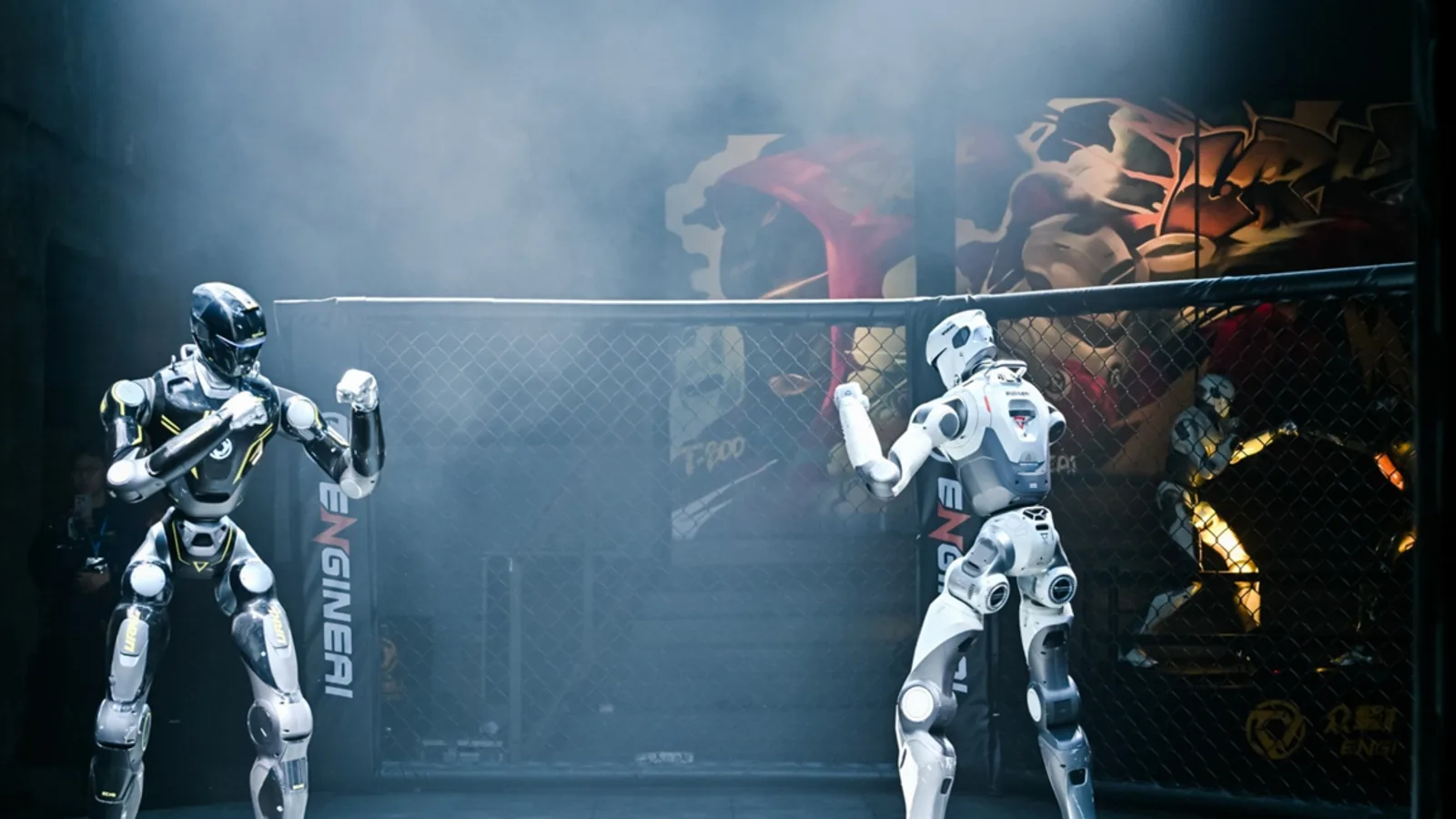
URKL Explained: Inside the World's First Commercial Humanoid Robot Combat League
URKL launched in Shenzhen in February 2026 as the first commercial humanoid robot free-combat league. Here's how it works and why it matters.
By Riley Cross · September 7, 2026 · 5 min read · combat-robotics
Robot combat sports have a new flagship competition. On February 9, 2026, Shenzhen EngineAI Robotics Technology Co. and Shenzhen Quanmingxing Robotics Technology Co. jointly launched URKL — Ultimate Robot Knock-out Legend — described as the world's first commercial free-combat league built specifically around humanoid robots.
What Makes URKL Different
Unlike research-driven showcases such as the World Humanoid Robot Games, URKL is positioned from day one as a "Technology + Sport" commercial product. It pairs full-contact combat between humanoid robots with what organizers call a "Chinese Robot Kung Fu" identity — leaning into martial arts spectacle rather than purely athletic benchmarking.
The launch conference brought together EngineAI founder and CEO Zhao Tongyang, Quanmingxing robot events lead Zhang Rui, and Muay Thai champion Buakaw Banchamek, who spoke about the league's direction and its industry roadmap. That mix of robotics executives and combat-sport royalty signals how URKL intends to position itself: part engineering proving ground, part martial arts entertainment property.
The Stakes: A Gold Belt Worth Millions
URKL isn't short on spectacle. Zhao Tongyang announced that the season's championship team will receive a 10-kilogram pure gold belt valued at roughly RMB 10 million (an amount in the range of $1.4 million USD), calling it the highest honor currently available in humanoid robotics competition. Regular-season matches are being hosted at the Longgang FRL Robot Club, with backing from local Longgang authorities aimed at establishing an ongoing, normalized operating schedule rather than a one-off event.
Timing: Riding a Bigger Robotics and Sports Wave
URKL's organizers explicitly tied the league's launch to a broader convergence of technology and global sport in 2026, pointing to momentum from the FIFA World Cup and the Asian Games as evidence that "Technology + Sports" crossovers are becoming a genuine growth category. The pitch: as embodied AI, motion control, and advanced materials keep improving, humanoid combat becomes commercially viable as both a demonstration of engineering progress and a standalone spectator sport.
How URKL Fits Into the Wider Robot Sports Landscape
URKL launched several months before rival humanoid combat programming like CyberHero's September 2026 Riyadh debut, giving it a first-mover position in commercial robot fighting specifically. It's a narrower, combat-only counterpart to the broader multi-sport programming of the World Humanoid Robot Games, and a domestic-China-first answer to what Hero Esports is now attempting on a global, multi-city scale.
For robot sports fans, URKL is worth tracking as a bellwether: if a dedicated combat league backed by a hardware manufacturer (EngineAI) can sustain a "normalized operational mechanism" — regular matches, a home venue, a standing championship belt — it suggests humanoid combat sport can move past one-off exhibition events and into something closer to a conventional sports league calendar.
What Comes Next
With EngineAI supplying the robotics hardware and Quanmingxing running the events side, expect URKL's 2026 season to build out a fuller fixture list at the Longgang FRL Robot Club, additional weight classes or divisions, and likely expansion talk once the league proves out its regular-season model. As with CyberHero and the World Humanoid Robot Games, URKL's early results will offer a real-time read on how close humanoid robots are to sustained, reactive, contact-based competition — historically one of the hardest problems in robot locomotion and control.
For a broader look at the sport around these machines, read our guide to how combat-robot arenas are built.
Engineering analysis
Our URKL impact and maintenance breakdown separates EngineAI's published competition requirements from the hardware details that still need documentation.