Best FPV Racing Simulator in 2025: Velocidrone, Liftoff, DRL Sim, and Uncrashed Compared
A pilot-tested ranking of the best FPV drone racing simulators in 2025. We break down realism, race-mode quality, hardware support, and which sim builds the skills that transfer to real racing.
By Sam Nakamura · September 22, 2025 · 11 min read · fpv-racing
If you fly FPV drones competitively, you spend more time in a simulator than you do on the sticks of a real quad. The best pilots in the world — including most of the Drone Racing League field and the top MultiGP national champions — train multiple hours a week in simulators between events. Sim time is cheaper than crashing carbon frames, it lets you practice tracks you do not have access to in real life, and the muscle memory transfers almost one-to-one to a real quad.
This is a pilot-perspective ranking of the best FPV racing simulators in 2025, focused specifically on what builds racing skill. We will get into casual freestyle and cinematic sims briefly, but the heart of this guide is: if you want to race faster, what should you fly in your living room?
How We Tested
We evaluated each simulator on five dimensions:
- Physics realism — does the sim quad respond to throttle, prop wash, and rate input the way a real quad does?
- Race mode quality — gate detection, lap timing, race-line ghosts, and multiplayer stability.
- Track ecosystem — how many tracks, how good is the in-game editor, and how active is the community sharing custom tracks?
- Hardware compatibility — works with real FPV transmitters, supports the standard rate/expo conventions, and runs cleanly on modest gaming hardware.
- Skill transfer — does the time you spend in this sim actually make you faster on a real race quad?
The testing was done with an ELRS-class transmitter wired in direct mode, a standard pair of FPV simulator-mode goggles, and both a high-refresh gaming monitor and a VR headset where supported.
The Ranking: Best FPV Racing Simulators in 2025
1. Velocidrone — Best Overall for Race Training
Velocidrone has been the de facto standard race simulator at the elite level for several years, and 2025 has not changed that. The physics model is the closest match to a real race quad of any simulator currently available, the multiplayer leagues are active and competitive, and the track library — both official and community-created — is enormous.
The race-mode features are what set Velocidrone apart. Race-line ghosts (so you can see your previous best lap as you fly the current one), per-section split timing, drag-race head-to-head modes, and weekly time-trial leaderboards built around real-world tracks are all baseline features. The community has reverse-engineered most of the world's major real-world racing courses inside Velocidrone, which means you can train on a track before showing up to fly it physically.
The downside is the entry price (around $25 plus track packs) and a UI that has not aged gracefully. Neither matters once you start flying.
Best for: Serious race pilots, MultiGP racers, anyone training for a specific real-world track.
2. Liftoff — Best for Casual Race Pilots and Freestyle Crossover
Liftoff: FPV Drone Racing by LuGus Studios remains the most polished and approachable race-capable simulator. The physics are good — not quite Velocidrone-level — and the production quality, presentation, and onboarding for new pilots are noticeably better. Liftoff also has Steam Workshop integration, which means custom tracks are one click away.
Liftoff: Micro Drones, the smaller-quad spinoff, is genuinely fun and has built up a loyal community of indoor and tiny-whoop pilots. For pilots who want one sim to cover both racing and freestyle, Liftoff is the most balanced choice.
Best for: Pilots crossing over from freestyle, beginners who want a smooth onboarding, anyone who values production polish.
3. DRL Simulator — Best for Aspiring Pro Pilots
The official Drone Racing League Simulator is the on-ramp to actual professional racing — DRL has historically signed pilots based on their performance in the sim. The tracks are recreations of the league's stadium courses, the production presentation is broadcast-grade, and the racing leaderboards feed directly into DRL's pipeline for new pilot recruitment.
The physics model is intentionally tuned to feel like the DRL Racer4/Racer5 spec quad, which is its own thing — fast, momentum-heavy, and built for stadium-scale gates. Skills transfer to other race quads, but pilots used to sub-200-gram race builds will notice the weight in the air.
If your goal is to race on the DRL circuit — or to win one of their qualifying tournaments — this is the sim you train in. For our deeper look at the league's stadium courses, see how FPV race tracks are designed.
Best for: Pilots aiming at the DRL pro path, fans who want to fly broadcast-style stadium tracks.
4. Uncrashed — Best for Cinematic and Freestyle, Solid Race Mode
Uncrashed: FPV Drone Simulator sits between the cinematic-FPV and racing categories. The environments are gorgeous, the physics are solid, and the included race modes are good enough for casual training. It is not the sim a top-50 MultiGP pilot trains in for nationals, but it is a sim that real pilots install and keep installed.
Best for: Pilots who fly both racing and cinematic, anyone who wants beautiful environments to practice in.
5. FPV.SkyDive and Tryp FPV — Niche Picks Worth Mentioning
Tryp FPV has a strong following among long-range and cinematic pilots, and it does include race tracks. FPV.SkyDive is more of a cinematic flight simulator than a race sim. Neither is what you want for serious lap-time training, but both are worth knowing about if you fly multiple disciplines.
What Actually Transfers from Sim to Real Quad
The single most overrated transfer skill is "feeling the throttle." That is real, but the more important transfers are:
- Stick discipline under stress. Sims punish over-correction the same way a real quad does. Hours of sim time build the hand-eye loop that lets you stay smooth at race pace.
- Line memorization. Repeating a track in a sim until you can fly it from memory is the highest-yield activity in race training. The physical memorization of where to look, when to roll, and where to throttle is portable to the real track.
- Crash recovery reflexes. Knowing how to flip back upright, save altitude after a missed gate, or recover from a tank-slap is muscle memory you build cheaply in a sim and pay for expensively at a real race.
What does not transfer well is wind, prop wash from your own quad in tight turns at low altitude, and the specific feel of a particular real-world battery and motor combination. For those, you need stick time on real hardware.
Setup and Hardware Notes
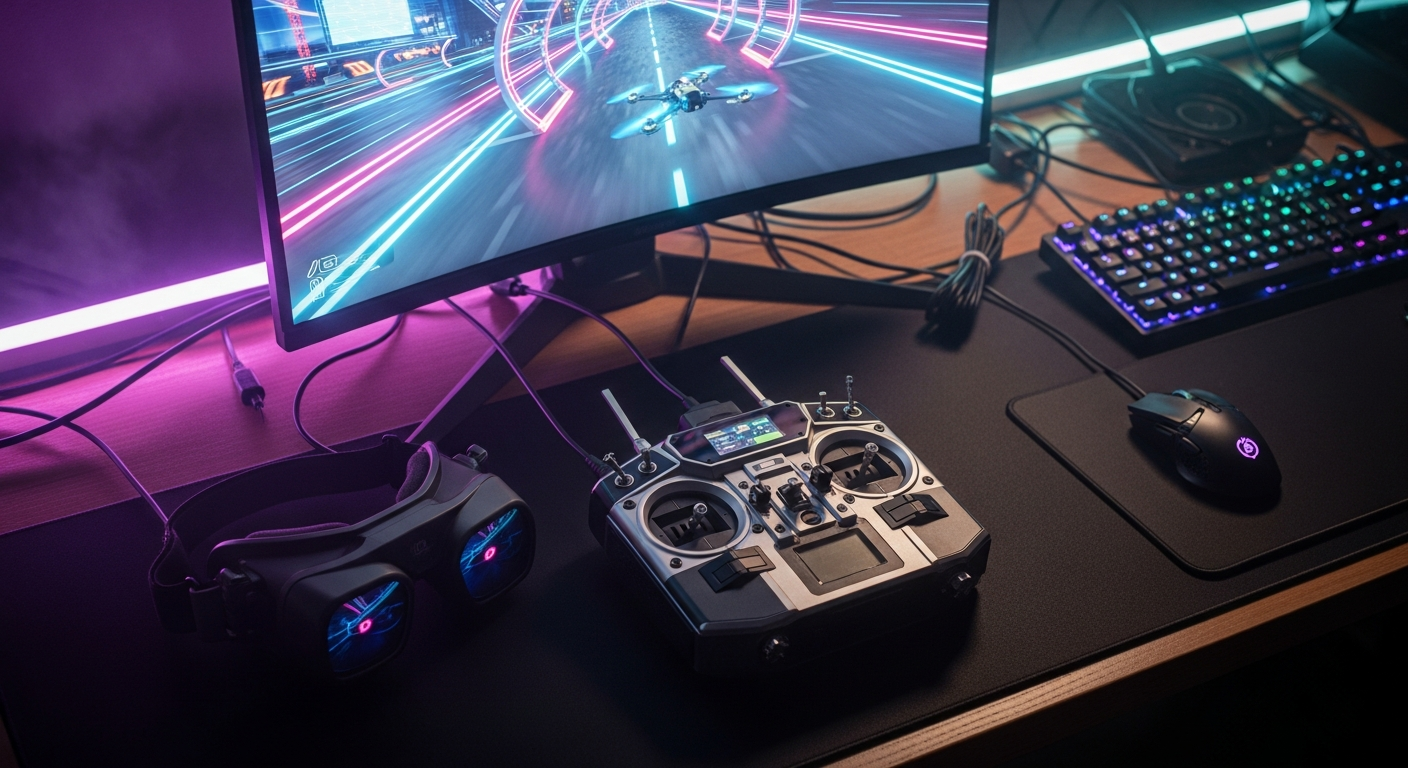
A serious sim setup needs three things: a transmitter you actually fly on, a low-latency input path, and a display that does not lie to you about latency.
Transmitter
Use the same transmitter you fly with on real quads. Most modern FPV radios (RadioMaster, Jumper, FrSky, T-Pro, T-X16S) have a USB joystick mode or PPM-over-USB simulator support. Configure the same rates and expo curves you use on your race quad — every minute you spend flying with mismatched rates is a minute building muscle memory you will then have to un-learn.
You can pick up a long-range transmitter and ELRS module bundle for under most build budgets if you do not already have one. Look for hall-effect gimbals — they are the upgrade that matters most for race precision.
Goggles or Monitor
Professional pilots are split. Some fly sim on a high-refresh monitor (240 Hz or higher) for the lower latency. Others fly in their actual race goggles using the simulator-input mode, on the principle that the visual setup should match race conditions exactly. Both work. If you can afford to, do most of your training in goggles — the visual field-of-view and head-position discipline are part of what you are training.
PC Spec
All of the simulators in this guide run at 144+ FPS on a mid-range gaming PC (Ryzen 5/Core i5-class CPU, RTX 3060-class GPU). VR support in Velocidrone and Liftoff bumps the requirements. Frame rate matters more than visual fidelity for race training — turn the eye candy down before you accept any frame drops.
Race Quad to Pair With
Once you are training in sim regularly, your real-world flying improves fast — make sure your hardware can keep up. For our current pick of race-ready quads to put your sim hours toward, see our best FPV racing drones guide. Match a competitive 5-inch frame with current motor and ESC stacks, and you will close the gap between your sim lap times and your real-world lap times faster than you expect.
Frequently Asked Questions
What is the best FPV simulator for beginners in 2025?
Liftoff is the most beginner-friendly polished simulator, with a smooth onboarding and good visual presentation. If you are sure you want to focus on racing rather than freestyle, Velocidrone has a steeper learning curve but more direct skill transfer to real-world racing.
Is Velocidrone or Liftoff better for race training?
Velocidrone is better for serious race training. The physics model is closer to a real race quad, the race-mode features are deeper, and the community track library includes recreations of most major real-world race courses. Liftoff is better for crossover pilots who fly both freestyle and racing, or for pilots who prioritize visual polish.
Do I need a real FPV transmitter to use a simulator?
Yes — practically speaking, every serious FPV simulator expects you to use an actual radio transmitter, not a gamepad. The good news is that any modern FPV radio has a USB simulator-input mode, and the radio you train with on the sim should be the same one you fly real quads with.
Will sim time actually make me a faster real-world pilot?
Yes — substantially, if you train with intent. Pilots who treat sim sessions like deliberate practice (specific tracks, specific lap-time goals, specific drills) improve their real-world race times measurably faster than pilots who only fly real quads. Mindless sim flying is much less useful than focused sim training.
Which simulator does the Drone Racing League use for pilot recruitment?
The official DRL Simulator is the league's recruitment funnel. DRL has historically signed pilots out of their open simulator tournaments, and the simulator's physics model is tuned to match the league's spec quad. If your goal is to race on the DRL circuit, that is the sim to focus on.
The Bottom Line
If you race FPV competitively, fly Velocidrone for skill development and the DRL Sim if you are aiming at that pro path. If you are crossing over from freestyle or you want a single sim that covers most use cases, fly Liftoff. If you fly cinematic and want a sim that is also competent at racing, fly Uncrashed.
Whichever sim you pick, the rule that matters most is that sim hours only count if they are deliberate. Pick a track, set a lap-time goal, and fly until you hit it. Then pick a harder one. That is what every top pilot in the world does between race weekends, and it is the single best thing you can do for your real-world flying.
For more from this beat, follow our FPV racing section and the rest of Sam Nakamura's coverage.